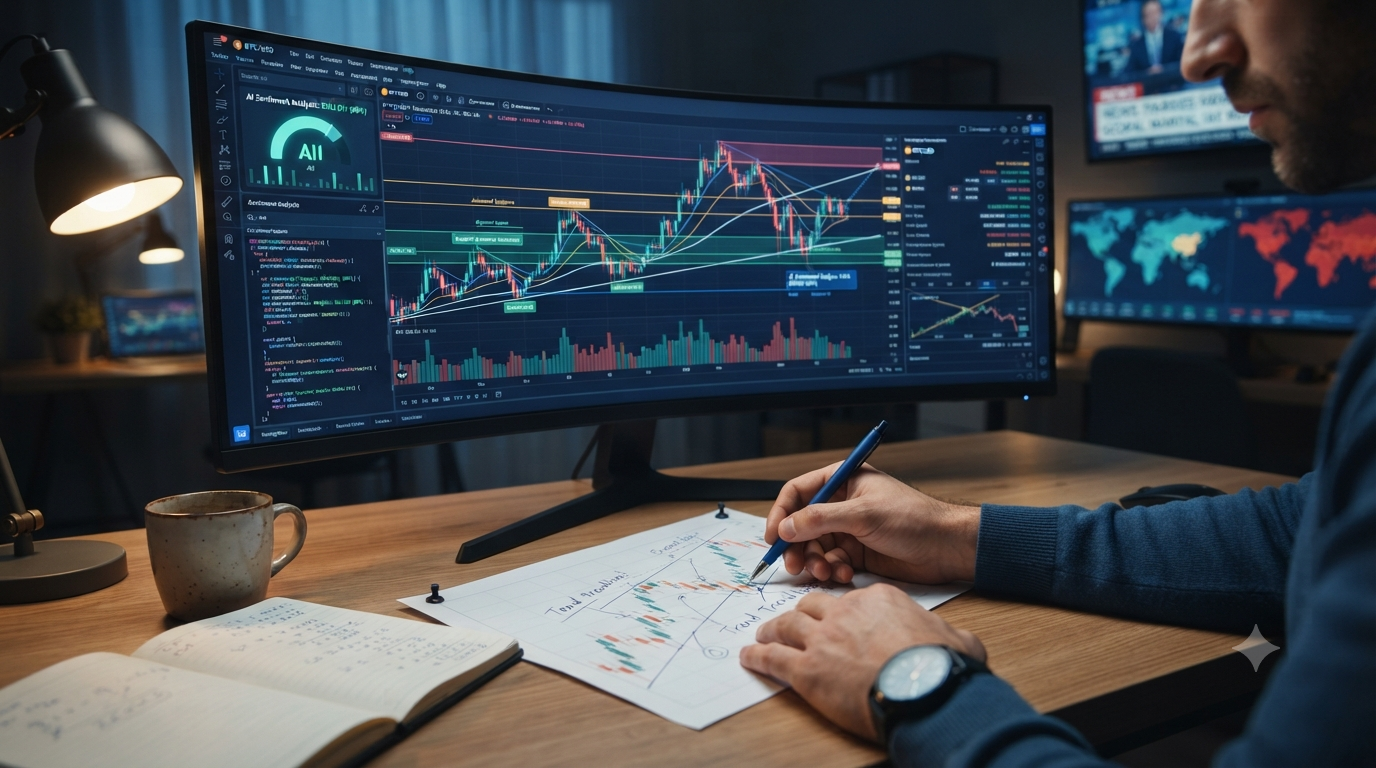
There was a time when becoming a successful trader meant spending hours every single day staring at raw candlestick charts, drawing endless trendlines, manually calculating moving averages, and waiting anxiously for a setup to materialize. It was tedious, mentally draining, and prone to every cognitive bias known to human psychology.
Fast forward to 2026, and the landscape has completely transformed. Today, the conversation is dominated by artificial intelligence, machine learning models, automated bots, and algorithmic trading suites promising to do the heavy lifting for you. We are told that we can automate our entries, let AI scan dozens of crypto pairs or forex charts simultaneously, and remove human emotion from the equation entirely.
Sounds like a dream come true, right? Well, speaking strictly from my own personal experience after testing various algorithmic trading systems, custom bots, and automated indicators over the years: I haven’t had much luck with pure algo trading. In fact, relying blindly on automated systems often taught me some of the most expensive lessons of my trading career.
In this comprehensive guide, we are going to take a realistic, unfiltered look at the reality of AI-assisted and algorithmic trading in 2026, where automated tools actually help, where they fail miserably, and why building your own judgment is still your greatest asset.
Important Disclaimer
Financial Risk Disclosure: Algorithmic trading, automated software, and AI-driven indicators involve a substantial risk of financial loss. Past performance of any algorithm, backtest, or automated bot is never indicative of future results. The content in this article is strictly for educational and informational purposes and does not constitute financial or investment advice. Always use strict risk management, thoroughly test systems in demo environments, and consult with a qualified professional before risking real capital.
The Allure of Algorithmic Trading: Why Everyone Wants Automation
It is easy to understand why retail traders flock to algorithmic solutions. The promises made by software vendors and AI hype are seductive:
- 24/7 Market Vigilance: Markets—especially cryptocurrencies—never sleep. Algorithms can monitor charts and execute trades while you are sleeping, working your day job, or eating dinner.
- Eliminating Emotion: The biggest killer of trading accounts is human emotion (FOMO, panic, greed, and revenge trading). A bot doesn’t feel fear or panic; it just executes code.
- Speed and Scale: Algorithms can process massive amounts of historical data, backtest strategies across thousands of candles in seconds, and execute orders in milliseconds.
On paper, it sounds foolproof. If you can code a winning strategy or plug in a high-end indicator suite—such as clean visual charting tools like VIP Algos on TradingView—you should theoretically be able to sit back and watch your account grow.
Unfortunately, the real world of live markets rarely cooperates with neat theory.
My Personal Reality Check: Why Algo Trading Didn’t Work for Me
When I first started experimenting with automated trading and algorithmic systems, I wanted it to be the holy grail. I tested various pre-built indicators, automated breakout bots, and rule-based scripts.
What I quickly discovered is that markets are organic, living ecosystems driven by human psychology, sudden macroeconomic shocks, and unpredictable news events—not static math formulas.
Here is why my experiments with pure algorithmic trading ultimately fell flat:
- Curve-Fitting and Historical Illusion: You can take almost any crappy trading strategy, tweak the parameters on historical data until it looks like a goldmine in backtests, and watch it completely self-destruct the moment you turn it on in live market conditions. This is known as curve-fitting. The market changes its regime constantly; what worked in a trending bull market in 2025 will often get chewed up and spit out in a choppy, sideways market in 2026.
- Black Swan Events and Flash Crashes: Algorithms lack common sense. If a sudden geopolitical crisis breaks out or a central bank makes an unexpected policy shift, an automated bot won’t pause and think, “Gee, maybe this news changes everything.” It will blindly execute its code right into a massive liquidity vacuum, resulting in catastrophic slippage and severe drawdowns.
- The False Sense of Security: Setting up a bot or an automated alert system lulls traders into a dangerous state of complacency. You stop paying attention to market structure, volume profiles, and fundamental news catalysts because you expect the code to do all the thinking for you. When the system hits a losing streak—and every system does—you are left staring at your screen wondering what went wrong because you didn’t understand the underlying mechanics.
Where AI and Automation Actually Add Value in 2026
Just because full “set-and-forget” algorithmic trading failed to live up to the hype for me doesn’t mean technology has no place in a modern trader’s toolkit. There is a massive difference between automating your decisions and using technology as an assistant.
Today, the most successful retail traders use AI and advanced charting tools for specific, limited tasks:
- Data Filtering and Chart Scanning: Instead of manually flipping through hundreds of stock, forex, or crypto tickers every evening, AI tools and custom screeners can filter out noise and flag assets approaching key technical levels (like major support zones or moving average squeezes).
- Visual Organization: Premium indicator packages and structured visual overlays help declutter your charts. Rather than guessing where take-profit zones or risk-reward ratios might sit, clean visual references help speed up your manual decision-making process.
- Backtesting Ideas Quickly: While backtests shouldn’t be trusted blindly, programming or testing basic logic allows you to see how a specific technical hypothesis behaved historically before you ever risk a single dollar of live capital.
The Unbeatable Human Element: Why Judgment Still Rules
At the end of the day, trading is an exercise in risk management and adaptability. Computers excel at repetitive math; humans excel at context, intuition, and situational awareness.
When a major economic headline drops—such as an unexpected Non-Farm Payrolls report or a surprise interest rate decision—an algorithm reacts instantly to numbers. A human trader, however, can read between the lines, assess overall market sentiment, recognize that the initial spike is a liquidity trap, and choose to stay on the sidelines (“buy the rumor, sell the news”).
That ability to step back, read the broader context, and exercise restraint is something no AI bot or automated script can replicate.
How to Approach Tech and Algos Safely
If you are currently experimenting with AI tools, automated indicators, or algorithmic setups on platforms like TradingView, keep these grounded rules in mind:
- Treat Tools as Confirmations, Not Deciders: Never take a trade solely because a bot or an AI indicator flashed a buy signal. Use the technology as a final check that aligns with your own manual analysis of support, resistance, and trend structure.
- Extensively Forward-Test: If you want to test an algorithmic strategy or automated setup, run it in a paper trading or demo account for months—not days—across different market conditions.
- Never Abdicate Risk Management: No algorithm can protect your capital better than you can. Always enforce strict stop-losses, keep your position sizes small (risking 1% or less per trade), and never leave an automated system running unattended with high leverage.
- Keep Your Expectations Realistic: Accept that losses are a normal part of business. No piece of software will ever eliminate market uncertainty.
Conclusion
The shift toward AI-assisted and algorithmic trading in 2026 offers incredible convenience, but it also creates dangerous traps for traders looking for a shortcut to wealth. My personal journey taught me that outsourcing your brain to a computer program is a fast track to losing money.
Technology should empower your decisions, not replace your judgment. By combining smart charting tools with rigorous manual analysis, strict risk management, and emotional discipline, you can navigate the modern markets with your eyes wide open—and your capital firmly protected.