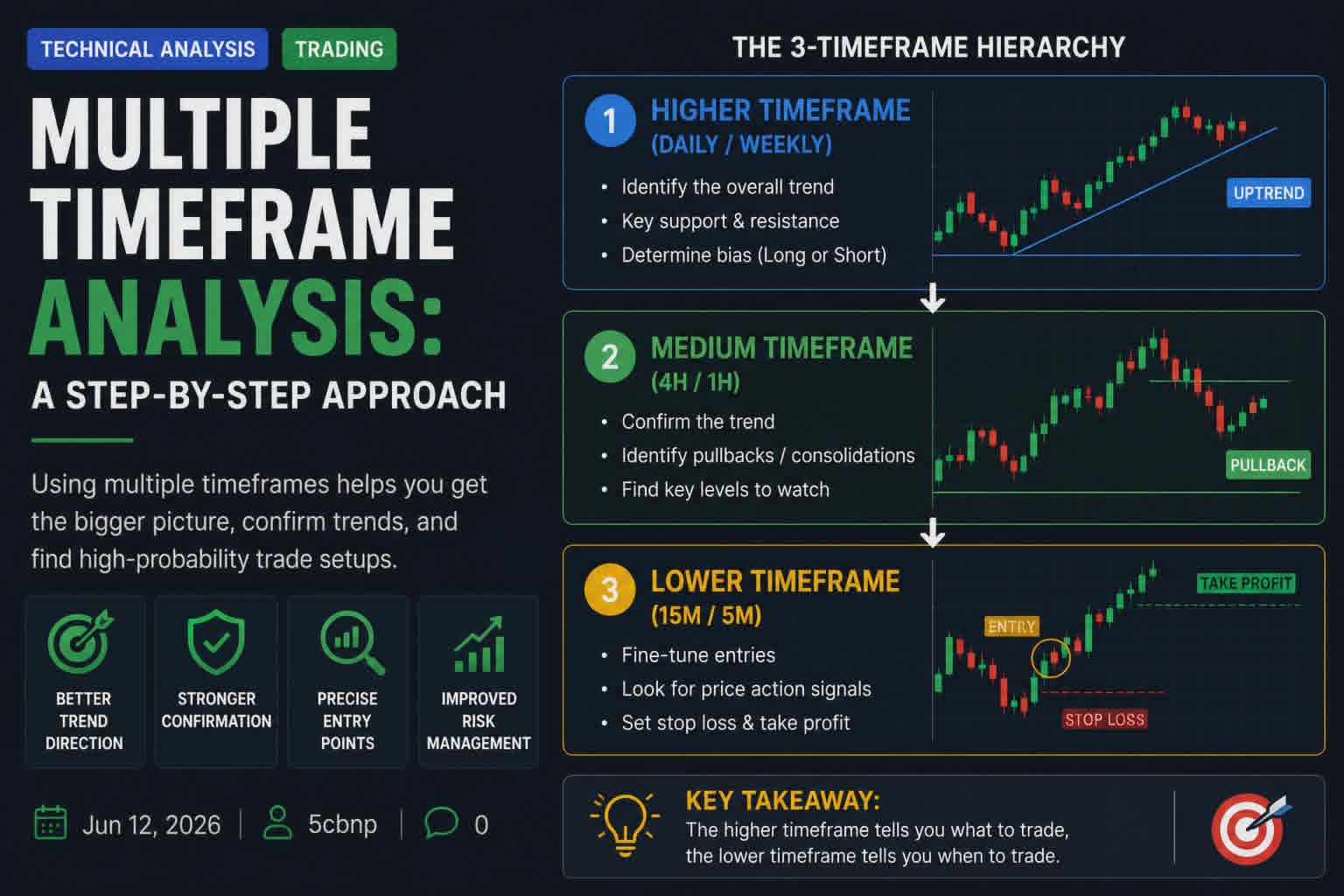
Multiple timeframes are useful until they become a way to find a chart that agrees with you.
I use three clocks of one market. I wrote the short version as one market, three timeframes. This page is the fuller walkthrough.
The stack
Weekly
Story of last week’s auction: high, low, close. I do not place tickets here.
Daily
Invalidation. The line that ends the sentence I wrote on Sunday.
Execution (4H, 1H, or 15m — pick one for a month)
The only clock that may create an order.
My Personal Perspective: Why MTF Check is My Go-To Method for the Best Positions
Over years of screen time and executing live orders, I’ve found that multiple timeframe analysis is quite simply one of the absolute best ways to enter a trade. Whenever I analyze a setup, I always do this check across multiple timeframes before I enter in order to secure the best possible position and avoid getting trapped by market noise.
From my point of view, zooming in and out of different charts bridges the gap between macro direction and micro execution. Looking at only a 5-minute or 1-hour chart is like navigating a jungle with a microscope—you lose sight of the massive cliffs ahead. By anchoring your analysis to higher timeframes for trend context and stepping down to lower intervals for surgical precision, you eliminate guesswork. Integrating MTF into your daily routine transforms your trading from a reactive guessing game into a structured, professional discipline.
Top-down, always. If I start on 5 minutes I will “discover” a trend that the daily does not have.
Alignment I require
– Weekly not obviously opposing
– Daily invalidation intact
– Execution gives a place to put the stop without breaking the risk cap
I do not need all three to chant. I need them not to fight.
What I cut
A fourth timeframe “to refine.”
A second symbol “for correlation” until the first market is under control.
Indicators that reset on every clock and produce six conflicting arrows.
How a session uses this
Sunday: weekly + daily map.
Session: execution chart only, with the two higher lines already drawn.
If execution disagrees, I pass. I do not scroll to 1 minute for permission.
This is how support and resistance stays attached to a story instead of becoming a forest of lines.
If the workspace looks like a cockpit, it is too heavy. Three panes on a laptop. If you cannot read them, you will not follow them.
Pros and Cons of Multiple Timeframe Analysis
Pros:
- Drastically increases win rates through multi-level technical confirmation
- Delivers superior risk-reward ratios for every executed position
- Minimizes emotional decision-making by replacing panic with a structured plan
- Adaptable across all asset classes (stocks, forex, crypto, and futures)
- Effectively filters out low-probability, choppy setups
Cons:
- Demands more preparation and analytical time before placing trades
- Can cause “analysis paralysis” if beginners clutter charts with too many variables
- Lower timeframes inherently contain more market noise
- Requires strict discipline to respect the higher timeframe trend
Common Mistakes Beginners Make
- Flipping through too many charts at once (stick strictly to three cohesive timeframes)
- Ignoring the higher timeframe bias and foolishly trading against the primary trend
- Pulling the trigger too early on lower timeframes without waiting for structural confirmation
- Overcomplicating the workspace with unnecessary indicator overlays
- Constantly second-guessing and switching timeframes mid-trade
Pro Tip: Start by mastering just three selected timeframes. Utilize split-screen layouts on platforms like TradingView to streamline your multi-chart workflow.
Key Takeaways
- Multiple Timeframe Analysis provides both the macro “big picture” and micro execution timing.
- Always top-down your analysis: start from the higher timeframe and work down to your entry chart.
- Trade in absolute harmony with the dominant trend for maximum statistical probability.
- Combine MTF execution with all the foundational skills you’ve learned: Support & Resistance, Candlesticks, Moving Averages, RSI, MACD, Fibonacci, Chart Patterns, and Volume.
- Practice this routine religiously on historical charts and log your findings in your trading journal.
- Patience and multi-chart alignment are the true cornerstones of consistent trading profitability.
Mastering multiple timeframe analysis serves as the ultimate capstone that ties together every technical concept covered throughout this series. It elevates scattershot trading into a structured, professional-grade framework.
In upcoming articles, we’ll dive into complete end-to-end trading strategies, trader psychology, and how to build a personalized business trading plan!