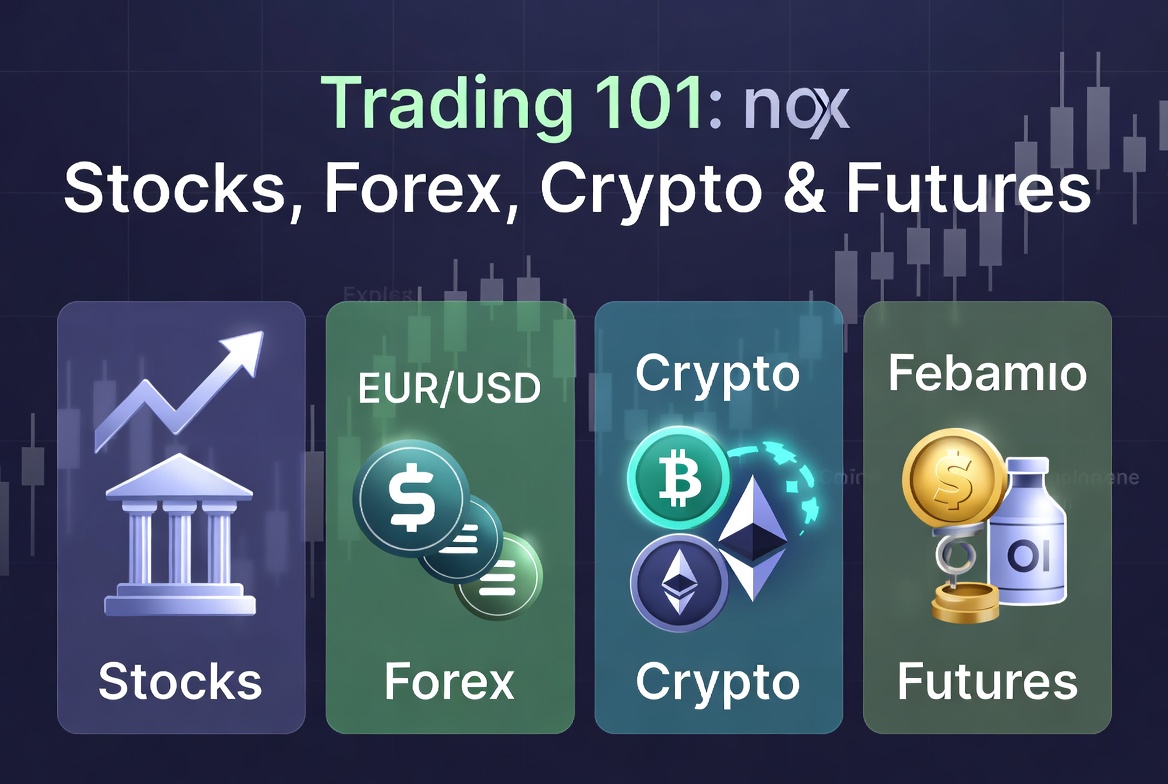
Trading can be an exciting way to participate in financial markets, but it also comes with significant risks. Whether you’re looking to build long-term wealth or generate short-term income, understanding the different markets is the essential first step.
In this beginner-friendly guide, we’ll break down the four major trading markets — Stocks, Forex, Crypto, and Futures — along with my personal mistakes, hard-earned lessons, and which market is truly the best starting point for new traders.
Important Disclaimer: Trading involves substantial risk of loss and is not suitable for everyone. Past performance does not guarantee future results. Always trade with money you can afford to lose and consider consulting a licensed financial advisor.
My Personal Journey: How I Learned the Hard Way
Over the years, I’ve traded across pretty much all of these major markets, and I won’t sugarcoat it—I haven’t always been profitable. Like many beginners, I had to learn things the hard way. Early on, I lost money trading with high leverage, treating the charts like a casino rather than a business.
If I can share one truth from my own scars, it is this: Spot trading stocks without leverage has consistently been where I’ve had the most success.
When you use high leverage without experience, a single bad market move will wipe your balance clean. It turns trading into pure gambling. On the flip side, my least successful and most stressful trades have almost always been in the crypto markets, where extreme 24/7 volatility can trigger massive emotional swings.
Trading is 90% psychological. The moment you trade with money you actually need in real life, fear and greed take over, and you will make catastrophic mistakes. That is why you should only ever trade with disposable risk capital, and why mastering your emotions is far more important than any indicator.
1. Stocks (Equity Trading)
Stocks represent ownership shares in publicly listed companies. When you buy a stock, you own a small piece of that company.
-
Key Features:
-
Traded on stock exchanges (NYSE, NASDAQ, etc.)
-
Trading hours are generally limited (e.g., 9:30 AM – 4:00 PM ET for US markets)
-
Influenced by company performance, earnings reports, industry news, and overall economy
-
Can generate income through price appreciation and dividends
-
-
Best For: Investors and traders who want a controlled environment without the constant threat of overnight liquidations.
-
My Take: This is where I recommend most people start. Sticking to spot trading on major companies allows you to build discipline and manage your psychology without the blinding speed of high leverage.
-
Pros: High transparency, strong regulation, potential dividend income, no overnight panic attacks from 3:00 AM market moves.
-
Cons: Requires more capital to start meaningfully, and markets close at night.
2. Forex (Foreign Exchange)
Forex is the largest financial market in the world, where currencies are traded in pairs (e.g., EUR/USD, GBP/JPY).
-
Key Features:
-
Operates 24 hours a day, 5 days a week
-
Extremely high liquidity
-
Traded in “lots” with high leverage (which increases both potential profit and loss)
-
Driven by economic data, interest rates, geopolitical events, and central bank policies
-
-
Best For: Traders who prefer fast-moving technical environments and have strict emotional control.
-
Pros: Lowest entry barrier (can start with small accounts), massive liquidity.
-
Cons: High leverage can lead to rapid, devastating losses if you lack discipline; complex macroeconomic factors.
3. Cryptocurrency
Crypto trading involves digital assets like Bitcoin, Ethereum, and thousands of altcoins.
-
Key Features:
-
Trades 24/7 with no market close
-
Extremely volatile — prices can swing 10%+ in a single day
-
Decentralized nature with less regulation
-
Influenced by news, adoption, regulation, and market sentiment
-
-
Best For: Tech-savvy traders comfortable with extreme risk.
-
My Take: Crypto has historically been my most psychologically exhausting market. The 24/7 nature means you can never truly “turn off,” which easily leads to burnout, revenge trading, and emotional mistakes. Approach with extreme caution.
-
Pros: Very low entry cost, exciting potential upside, 24/7 access.
-
Cons: High volatility, security risks, emotional fatigue, high potential for reckless gambling behavior.
4. Futures
Futures are standardized contracts to buy or sell an asset (commodities, indices, currencies, etc.) at a predetermined price on a specific future date.
-
Key Features:
-
Traded on regulated exchanges (CME, etc.)
-
High leverage available by default
-
Includes commodities (oil, gold), stock indices (S&P 500), and more
-
Used for both hedging and speculation
-
-
Best For: Experienced traders with strict risk management frameworks.
-
Pros: Excellent liquidity in major contracts, transparent pricing.
-
Cons: Expiration dates add complexity, requires strict discipline and larger account sizes.
Key Differences at a Glance
| Market | Trading Hours | Volatility | Leverage | Regulation | Best For | Starting Capital |
| Stocks | Limited | Medium | Low (Spot = 1x) | High | Long-term investors & spot traders | Medium |
| Forex | 24/5 | Medium | Very High | High | Flexible short-term | Low |
| Crypto | 24/7 | Very High | High | Medium | High-risk appetite | Very Low |
| Futures | Extended | High | High | High | Advanced traders | Medium-High |
Which Market Should You Start With?
My recommendation based on years of screen time and painful lessons: Start with Stocks on a spot basis.
Stocks move at a sane, controlled pace, giving you the breathing room required to develop emotional control.
-
Move to Forex if you want more trading hours and a pure focus on technical execution.
-
Approach Crypto only if you have a high risk tolerance and can handle intense psychological pressure.
-
Explore Futures only after gaining years of real market experience.
Final Pro Tip from Experience: Never trade with money you need to pay your bills. The moment you treat trading like a get-rich-quick scheme or a casino, the psychological pressure will destroy your discipline. Focus first on risk management (never risk more than 1–2% per trade), stay away from high leverage, and treat your first year as an education cost.
Example: NVDA Daily Chart (Clean View)
Here is a look at the NVDA daily chart without any drawings.
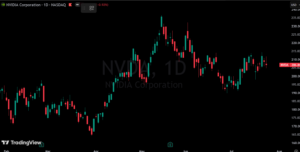
Image 1: The daily chart of NVDA. This clean view allows us to identify the major swing high in late 2021, the significant downtrend throughout early 2022, and the subsequent accumulation and recovery. By studying this raw price action, we can see where the trend changed character.
Learning to see this structure is your first step. Once you can identify these zones on a clean chart, you are ready to plan trades.
Pillar 2: The Only Way to Survive — Risk Management
You can be right on the market direction 60% or 70% of the time and still go broke if you don’t manage your risk correctly. In my trading career, mastering risk-reward (RR) ratios was the single biggest turning point.
An RR ratio compares the distance from your entry point to your profit target (reward) against the distance from your entry point to your stop-loss order (risk).
For example, a 1:3 Risk/Reward ratio means that for every $1.00 you are willing to lose on a trade, you are aiming to make $3.00 in profit. By maintaining a positive RR ratio on your trades, you don’t need to win every time to be profitable overall.
Example: Planning a Long Trade on NVDA
Let’s take the NVDA chart from before and apply a theoretical long (buy) position setup. We have identified a potential support level and are planning to buy the breakout.
Image 2: This chart shows a hypothetical long trade setup on NVDA. Let’s break down the math shown in this risk/reward tool:
-
Green Box (Reward): The take-profit target is set significantly higher than the entry price, targeting the next major resistance level.
-
Red Box (Risk): The stop-loss order is placed just below the recent swing low. This is our “uncle point”—if the price falls to this level, the trade idea is invalidated, and we exit to preserve capital.
-
The Setup: As you can see, the potential reward (green box) is more than double the potential risk (red box). This is a positive risk-reward setup.
My Personal Rule: I never take a trade where the potential reward is not at least double the risk (a 1:2 RR ratio or better). If the math doesn’t make sense, I don’t take the trade, no matter how good it looks.
Pillar 3: The Road Map — Fibonacci Retracements
One of my favorite tools for identifying high-probability entry zones within an established trend is the Fibonacci Retracement tool.
In trading, markets do not move in straight lines; they trend, then pull back (retrace), and then continue trending. Fibonacci retracement levels help us identify where those pullbacks are likely to end and where the original trend might resume.
Based on the mathematical sequence, the key levels traders watch are:
-
50%: The halfway back point (not technically a Fibonacci ratio, but widely used).
-
61.8% (The “Golden Pocket”): Often the deepest level of retracement before a trend continues.
-
38.2%: A shallower retracement level for strong trends.
Example: Applying Fibonacci to an NVDA Trend
Let’s go back to the NVDA chart. We identified a strong impulsive move upward. We can now apply the Fibonacci tool from the beginning of that move to the peak of that move to find potential “buy the dip” zones.
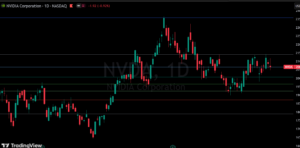
Image 3: The NVDA daily chart with Fibonacci retracement levels applied to the recent uptrend. As you can see, the subsequent pullback found strong support right at the key Fibonacci levels (marked with the horizontal lines). A trader looking to buy the dip would have watched these zones closely for price action signals (like a reversal candle) to enter the market in line with the overall trend.
Conclusion: Bringing It All Together
Technical analysis is not about predicting the future; it’s about creating a high-probability plan based on:
-
Reading the clean price action to see the trend.
-
Applying strict risk management to ensure your winners are bigger than your losers.
-
Using tools like Fibonacci to identify potential entry points.
By combining these three elements, you stop gambling and start trading like a business.