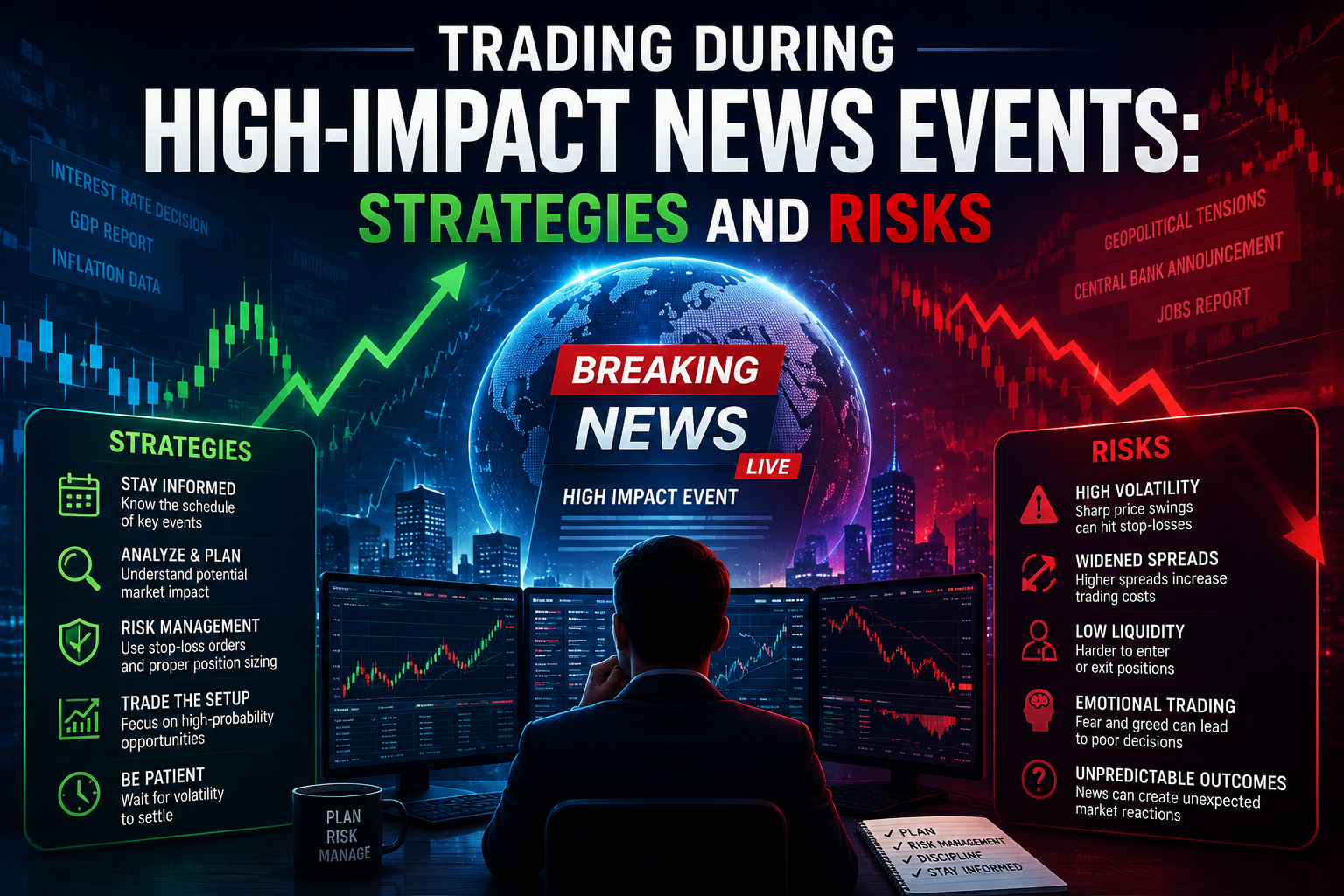
High-impact news events are among the most volatile and profitable — yet also the most dangerous — moments in the financial markets. Whether it’s a Federal Reserve interest rate decision, Non-Farm Payrolls (NFP) report, CPI inflation data, or major corporate earnings, these releases can cause massive price swings in seconds.
Many beginners get burned during these events, while experienced traders often view them as high-reward opportunities. In this detailed guide, we’ll explore the risks involved, proven strategies for trading news events, and practical rules to protect your capital.
Important Disclaimer: Trading involves substantial risk of loss and is not suitable for everyone. This article is for educational purposes only and does not constitute financial advice. News trading is extremely risky — many professional traders reduce size or sit out entirely during major events.
My Personal Perspective: Navigating the Chaos of Pre-Market, Post-Market, and News Volatility
If there is one arena in trading that has humbled me more times than I care to admit, it’s trading right through high-impact news or erratic pre-market and post-market sessions. In my early days, seeing a stock gap up or down 10% in pre-market trading felt like an irresistible invitation to jump right in. Time and time again, I learned the hard way that liquidity dries up outside regular hours, and spreads widen to absolute extremes. You end up getting filled at the worst possible prices, caught in wild whipsaws before the opening bell even rings.
From my own hard-earned experience, pre-market and post-market volatility require a completely different mindset. Institutional heavyweights use these thin-liquidity windows to trap retail traders by pushing prices aggressively on low volume. If you try to chase an earnings miss or a breaking headline during pre-market hours without letting the dust settle, you are essentially gambling. Nowadays, my golden rule is simple: respect the power of market hours, wait for the actual market open, let the institutional volume digest the news, and only then look for structured technical setups on your charts.
Why High-Impact News Events Matter
High-impact events create sudden shifts in supply and demand as new information hits the market. Algorithms, institutions, and retail traders all react simultaneously, often leading to sharp moves, increased volatility, and temporary loss of liquidity.
Major High-Impact Events Include:
- Central Bank Decisions (FOMC, ECB, BoE)
- Economic Data Releases (NFP, CPI, PPI, GDP, Unemployment)
- Corporate Earnings (especially from mega-cap companies)
- Geopolitical Developments and unexpected breaking news
These events can temporarily override technical levels, making pure technical trading very challenging unless factored into broader market context.
Insights from Professional Traders on News and After-Hours Volatility
When looking at how seasoned market veterans handle high-impact releases, their approach centers entirely around risk mitigation rather than trying to predict the unpredictable:
- The “Fade the First Move” Philosophy: Many professional prop traders note that the initial headline reaction is almost always exaggerated by high-frequency trading algorithms. Waiting for the emotional overshoot to exhaust itself often provides the cleanest counter-trend trade back toward equilibrium.
- The Thin-Liquidity Warning: Veteran market makers frequently caution against trading during pre-market and post-market hours unless you are managing an existing swing position. The lack of depth in the order book means a single large market order can cause massive slippage.
- Capital Preservation First: As legendary traders often emphasize, missing a move fueled by news is completely free. Losing 20% of your account trying to chase a volatile news spike is irreversible damage. Your job is to stay in the game long enough to capture predictable setups.
The Risks of Trading High-Impact News
1. Extreme Volatility and Slippage: Spreads widen dramatically, and stop-loss orders can execute far from your intended price.
2. Unpredictable Reactions: Markets often move on the “surprise factor” rather than the actual numerical data. A positive earnings report can trigger immediate selling if expectations were set impossibly high.
3. False Breakouts and Whipsaws: Price can violently spike in one direction to trap breakout traders before reversing sharply in the opposite direction within minutes.
4. Emotional Pressure: Fast-moving candles amplify fear and greed, leading to impulsive decision-making.
5. Pre-Market and Post-Market Traps: Low liquidity outside standard trading hours creates exaggerated price gaps that regular stops cannot protect against.
Strategies for Trading High-Impact News Events
Strategy 1: The Straddle / Strangle (Volatility Play)
- Place a buy stop above resistance and a sell stop below support before the news drop.
- Allows you to catch the breakout in whichever direction the market commits to.
- Risk: False breakouts followed by sharp reversals can trigger both stops.
Strategy 2: Trade the Reaction (Post-Release)
- Wait 5 to 30 minutes after the release for initial panic volatility to settle.
- Analyze the actual vs expected data and observe how the market actually handles the news.
- Enter in the direction of the dominant institutional move once price stabilizes.
Strategy 3: Avoidance and Standing Aside
- Sit out the event completely or reduce your position sizing to a fraction of normal.
- Many successful professionals consider flat positioning during major high-impact releases to be their best edge.
Key Rules for Safe News Trading
- Know the Calendar — Track high-impact events using reliable tools like Investing.com or Forex Factory.
- Respect Pre-Market and Post-Market Gaps — Never trade thin liquidity hours without a clear hedging plan.
- Use Proper Position Sizing — Risk no more than 0.5% of your account if you choose to participate during news windows.
- Avoid Trading Right at the Release Bell — Let the institutional algorithms fight it out during the first few chaotic minutes.
- Combine Technicals with Fundamentals — Always cross-reference breaking news against major support and resistance zones from your higher timeframes.
Real-World Examples
Example 1: Non-Farm Payrolls (NFP) Strong job data triggered an initial sharp USD spike, but traders who waited for the post-news pullback to key moving averages caught a much cleaner, sustainable continuation trend.
Example 2: Pre-Market Earnings Gap A tech stock gapped down 8% in pre-market trading on an earnings miss. Impatient retail buyers tried to catch the falling knife immediately at 8:00 AM and got severely crushed as institutional selling continued right through the open.
Key Takeaways
- High-impact news and pre/post-market sessions offer immense volatility that can either build or destroy an account in seconds.
- The safest and most professional approach for most traders is to reduce exposure or sit out entirely during high-impact releases.
- When you do trade news, wait for initial volatility to subside, respect thin-liquidity hours, and rely on strict risk management.
- Combine fundamental awareness with technical execution to stay consistently profitable over the long run.