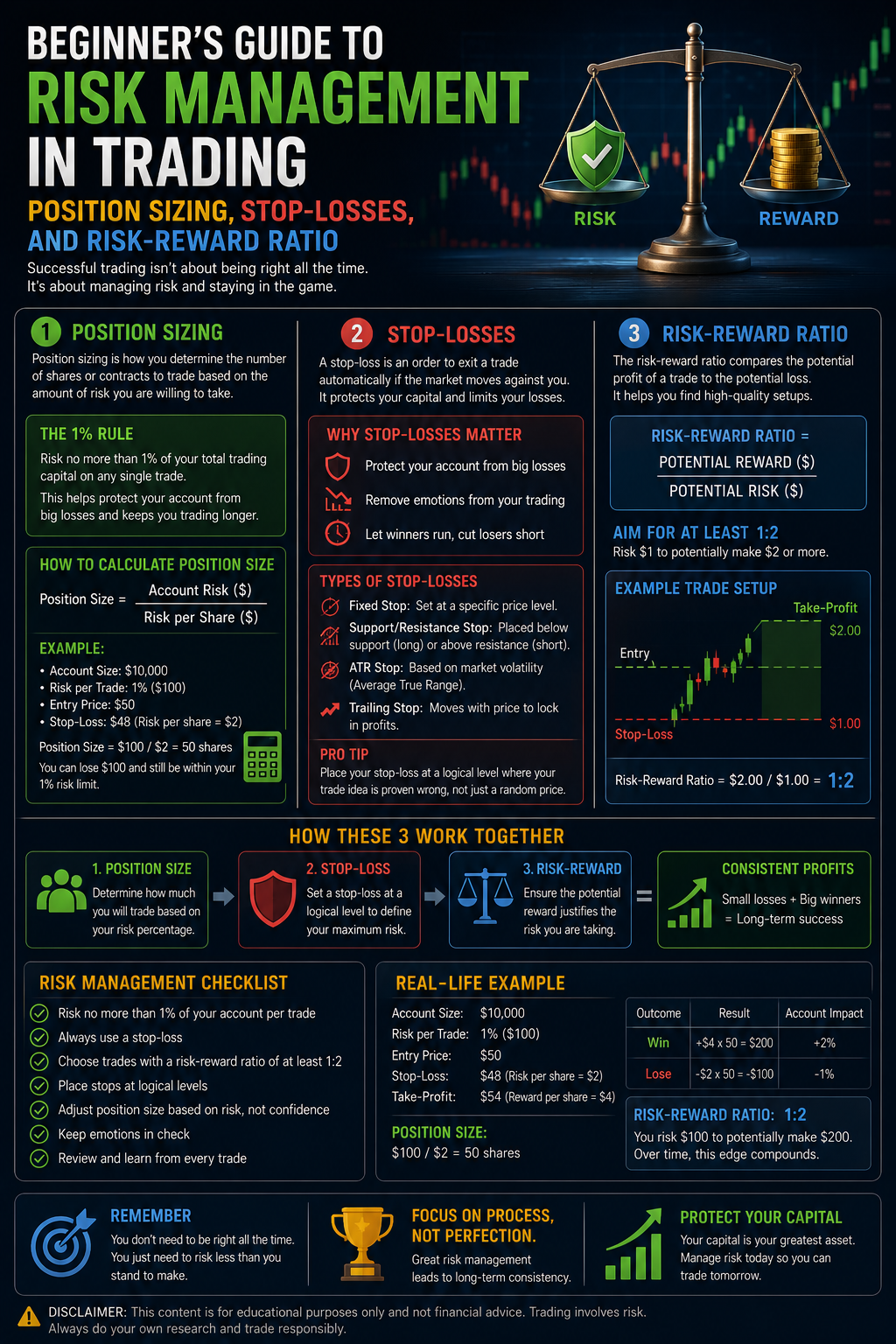
Beginner’s Guide to Risk Management in Trading: Position Sizing, Stop-Losses, and Risk-Reward Ratio

Many new traders focus heavily on finding winning setups and strategies, but the real secret to long-term success in trading is risk management.

Even the best trading strategy will fail without proper risk controls. Professional traders don’t just aim to win — they focus on surviving losing streaks and protecting their capital.

In this comprehensive beginner’s guide, you’ll learn the three pillars of risk management: position sizing, stop-losses, and risk-reward ratio. Mastering these will dramatically improve your trading results and protect your account from big losses.

Forex 2026: The Beginner Path That Works 📈 | FXNX

Important Disclaimer: Trading involves substantial risk of loss and is not suitable for everyone. This article is for educational purposes only and does not constitute financial advice. Always trade with money you can afford to lose.

My Personal Perspective: The Hard Truth About Discipline and Emotions

If you ask almost any successful trader what separates the winners from the losers, they will tell you it all comes down to psychological discipline. From my own personal experience, this is where the vast majority of traders fail. You can have the best strategy in the world, but when you are sitting through a losing streak, your emotions take a heavy hit.

When you are losing money, it hurts. The psychological pain triggers anger, frustration, and the dangerous urge to revenge-trade your way back to even. Maintaining emotional stability and strictly executing your risk management rules when everything inside you is screaming to move your stop-loss or risk more is the hardest part of trading. It is an everyday mental battle, but mastering that discipline combined with a proper risk-reward ratio is the only way to survive long-term.

Why Risk Management Matters

The harsh reality is that even highly successful traders are wrong 40–60% of the time. What separates winners from losers is how they manage their losses.

Without risk management:

  • A few bad trades can wipe out your entire account.
  • Emotions (fear and greed) take complete control of your decisions.
  • Recovery becomes extremely difficult due to the mathematics of percentage losses.

Rule of thumb: Your primary goal as a trader is capital preservation, not making money on every single trade.

1. Position Sizing – How Much to Risk Per Trade

Position sizing is the process of deciding how much money to put into each trade.

The Golden Rule: Never risk more than 1–2% of your total trading capital on a single trade.

Example:

  • You have a $10,000 trading account.
  • You decide to risk a maximum of 1% per trade = $100.

If your stop-loss is 50 pips away on EUR/USD or $2.50 away on a stock, you calculate your position size so that losing that distance only costs you $100.

How to Calculate Position Size: Position Size = (Account Risk Amount) ÷ (Stop-Loss Distance in Price)

This simple rule ensures that even a string of 10 losing trades in a row only reduces your account by about 10–20% — giving you the psychological breathing room and capital needed to recover.

2. Stop-Losses: Your Safety Net

A stop-loss is a pre-determined price level where you automatically exit a losing trade to limit your loss.

Why you must always use stop-losses:

  • Protects you from catastrophic, account-destroying losses.
  • Removes emotion from decision-making when the market moves against you.
  • Enforces strict structural discipline.

Best Practices for Stop-Loss Placement:

  • Place stops beyond key support/resistance levels.
  • Use Average True Range (ATR) for volatility-based stops.
  • Avoid placing stops at obvious round numbers where retail stops cluster.
  • Never move your stop further away mid-trade to “give it more room”—this is an emotional trap that ruins accounts.

Mental Stop vs Hard Stop: Beginners should always use hard stops (automated orders) until they develop ironclad discipline.

🔒 Risk Management • Risk only 1–2% of your capital per | RajatGupta91 on Binance Square

3. Risk-Reward Ratio (RRR)

The risk-reward ratio compares how much you risk versus how much you aim to gain.

Recommended Minimum: 1:2 (risk $1 to make $2)

Example:

  • You risk $100 on a trade based on your stop-loss distance.
  • You target $200 profit matching a 1:2 ratio.
  • Even if you win only 50% of your trades, you will still be consistently profitable over time.

Higher ratios (1:3 or 1:4) are better for swing traders, while day traders may accept 1:1.5 with higher win rates.

Real-World Trading Examples

Example 1: Stock Trading (Apple – AAPL)

  • Account size: $20,000 → Risk 1% = $200
  • Stock price: $230
  • Stop-loss: $225 (risk $5 per share)
  • Position size: 40 shares ($200 risk)
  • Target: $240 (1:2 reward, $400 potential profit)

Example 2: Forex Trading (EUR/USD)

  • Account: $5,000 → Risk 1% = $50
  • Stop-loss: 30 pips
  • Position size: 0.17 standard lots (calculated via position size formula)
  • Target: 60+ pips (1:2+ ratio)

Example 3: Losing Streak Protection A trader with proper 1% risk management can survive 20 losing trades in a row with only an ~18% account drawdown. Without it, the same streak could completely wipe out the account.

Common Risk Management Mistakes Beginners Make

  • Risking too much per trade (5–10%+) out of greed.
  • Not using stop-losses because of “hoping it comes back.”
  • Moving stops further away during losing trades to avoid taking a loss.
  • Taking revenge trades after a loss to try and get back at the market.
  • Poor risk-reward ratios (risking $1 to make $0.80).
  • Ignoring overall portfolio correlation and risk.

How to Build Your Personal Risk Management Plan

  1. Decide your maximum risk per trade (1% recommended for beginners).
  2. Define your maximum daily/weekly risk limit (e.g., stopping for the day after 3 losses).
  3. Always calculate position size before entering any market.
  4. Set both stop-loss and profit target before every trade.
  5. Keep a detailed trading journal to track your psychological state and execution.
  6. Review your performance monthly to identify emotional leaks.

Pro Tip: Start with a demo account until you can consistently follow your risk rules and emotional boundaries for at least 100 trades.

Key Takeaways

  • Risk management and emotional discipline are far more important than any strategy.
  • Never risk more than 1–2% of your account on a single trade.
  • Always use stop-losses and aim for at least a 1:2 risk-reward ratio.
  • Position sizing and self-control turn good strategies into sustainable ones.
  • Discipline, patience, and consistency beat intelligence in trading every single time.
  • Protect your capital first — the profits will naturally follow.

Mastering risk management is what turns struggling beginners into consistently profitable traders. It may feel restrictive and emotionally taxing at first, but it gives you the greatest gift in trading: longevity.

In the next articles, we’ll combine these risk principles with the technical tools you’ve learned (candlesticks, support/resistance, moving averages) to build complete, rule-based trading strategies.

Leave a Comment

Content on traderslook.com is for educational and informational purposes only and should not be construed as professional financial advice "As an Amazon Associate I earn from qualifying purchases"