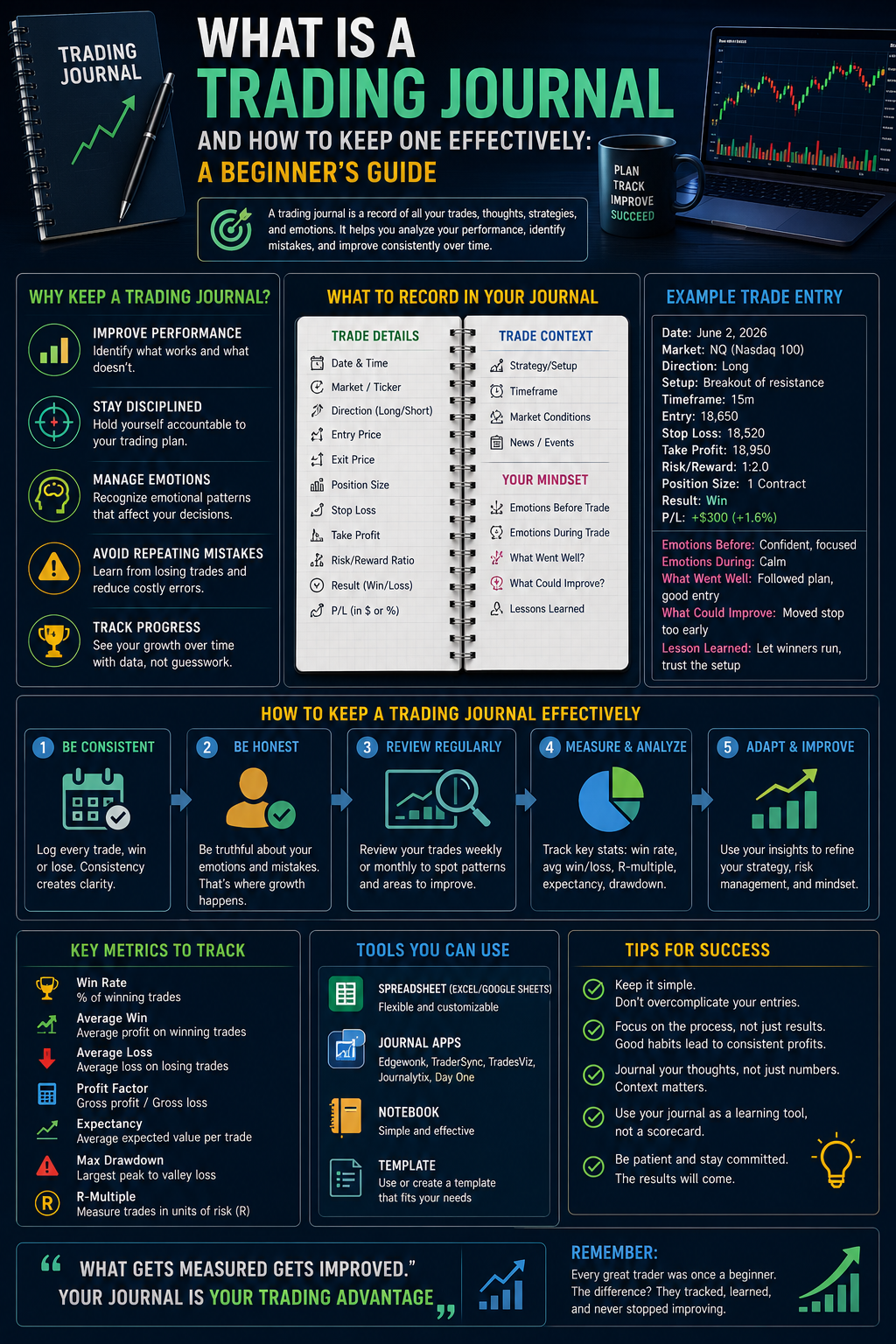
One of the biggest differences between amateur traders and consistently profitable ones is the use of a trading journal.
While most beginners chase hot tips and strategies, serious traders treat trading like a business — and every successful business tracks its performance.
A trading journal is a detailed record of every trade you take, along with your thoughts, emotions, and outcomes. In this comprehensive guide, you’ll learn exactly what a trading journal is, why it’s essential, and how to maintain one effectively to accelerate your learning curve.
Important Disclaimer: Trading involves substantial risk of loss and is not suitable for everyone. This article is for educational purposes only and does not constitute financial advice.
What is a Trading Journal?
A trading journal is a systematic record of your trading activity. It goes far beyond simply noting whether a trade was a winner or loser. It captures the full context of each trade — technical setup, fundamental factors, emotional state, and lessons learned.
Think of it as your personal trading database and performance coach in one.
Why Every Trader Needs a Trading Journal
The markets are full of randomness and emotions. Without a journal, you’ll repeat the same mistakes and struggle to improve.
Key Benefits:
- Identifies your strengths and weaknesses
- Removes emotional bias from performance evaluation
- Tracks the effectiveness of your strategy over time
- Improves discipline and accountability
- Provides concrete data for strategy refinement
- Helps with tax reporting and performance analysis
Studies and trader surveys consistently show that journal users achieve significantly better long-term results than those who don’t keep records.
What Should You Include in Your Trading Journal?
A good trading journal should contain both objective and subjective information:
Objective Data:
- Date and time of trade
- Asset (stock, forex pair, crypto, etc.)
- Entry price, exit price, and position size
- Stop-loss and take-profit levels
- Risk-reward ratio
- Outcome (profit/loss in $ and %)
- Reason for entry (setup type, indicator signals, etc.)
- Charts screenshots (before and after)
Subjective Data:
- Your trading plan/rules followed?
- Emotional state before, during, and after the trade
- What went well?
- What could have been improved?
- Lessons learned
- Confidence level in the setup (1–10)
How to Set Up Your Trading Journal
Option 1: Spreadsheet (Recommended for Beginners)
- Use Google Sheets or Microsoft Excel — free and powerful
- Create separate sheets for Trade Log, Monthly Summary, and Strategy Performance
Option 2: Notion or Dedicated Apps
- Notion templates offer beautiful layouts
- Trading-specific apps like Edgewonk, TraderSync, or Tradervue (paid but advanced)
Option 3: Simple Notebook
- Good for absolute beginners focusing on psychology
Pro Tip: Start simple. A well-maintained basic spreadsheet is far better than an unused fancy tool.
Step-by-Step Guide to Logging Trades Effectively
- Pre-Trade — Write down your setup, entry rules, stop-loss, target, and position size before you enter.
- During the Trade — Note any emotional impulses or deviations from your plan.
- Post-Trade — Immediately log the outcome and fill in the full details while the trade is fresh in your mind.
- Add Screenshots — Annotate charts showing entry, stop, and target levels.
- Weekly/Monthly Review — Analyze patterns in your performance.
How to Review Your Trading Journal (The Most Important Part)
Logging trades is useless without regular reviews.
Weekly Review:
- Check win rate, average risk-reward, and largest losses
- Look for recurring mistakes
Monthly Review:
- Calculate overall profitability
- Compare strategy performance
- Adjust rules based on data
Questions to Ask During Reviews:
- Which setups are actually profitable?
- Am I following my trading plan?
- Are my losses due to bad setups or poor risk management?
- How is my psychology affecting results?
Real-World Example
Trade Entry:
- Asset: AAPL stock
- Date: June 10, 2026
- Setup: Bullish hammer at support + 50 EMA bounce
- Entry: $228.50
- Stop-Loss: $225.80 (1.2% risk)
- Target: $235 (1:2.8 RRR)
- Position Size: 1% account risk
- Outcome: +$380 (won)
- Lesson: Strong confluence worked well. Stayed disciplined.
By reviewing 50+ similar trades, you might discover that this setup works 68% of the time when volume confirms — valuable data for the future.
Common Mistakes When Keeping a Trading Journal
- Being too lazy or inconsistent with entries
- Only logging winning trades (huge bias!)
- Not including emotions and psychology
- Failing to review the journal regularly
- Making it too complicated (leading to abandonment)
Solution: Start with just 5–10 key fields and build from there. Consistency beats perfection.
Advanced Tips for Maximum Results
- Track your equity curve (visual graph of account growth)
- Categorize trades by setup type, time of day, or market condition
- Include pre-market routine and overall mindset notes
- Review your journal with a trading buddy or mentor
- Update your trading plan based on journal insights
Key Takeaways
- A trading journal turns random trading into a deliberate learning process.
- Focus on both numbers (P&L, win rate) and psychology.
- Review your journal consistently — this is where real improvement happens.
- Start simple today. Even logging your next 20 trades will give you powerful insights.
- Combine your journal with strong risk management (1–2% per trade) for the best results.
Keeping a detailed trading journal is one of the highest-ROI activities you can do as a trader. It accelerates learning, builds discipline, and ultimately helps you become consistently profitable.
In future posts, we’ll dive into specific strategies and how to analyze your journal data for better performance.