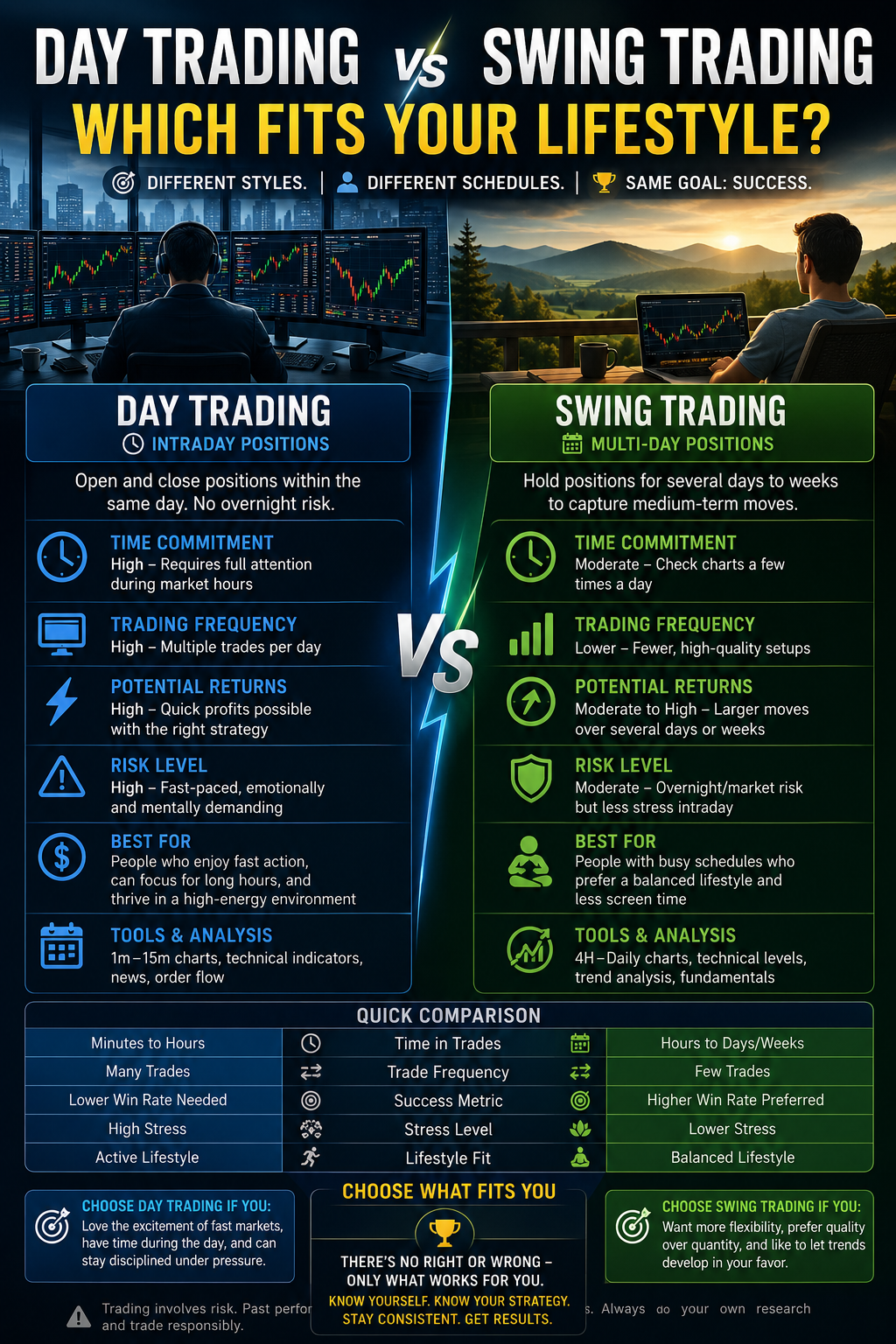
Style is a calendar problem before it is a strategy problem.
If you have 40 minutes after work, you do not have a day-trading job. You have a window. Forcing 5-minute charts into that window is how swing rules die and FOMO gets a time stamp.
Two jobs
Day / session
You are in front of the ticket during the window. Stops are tighter. News modes matter more. The opening range is part of the job.
Swing
Decisions on daily or 4H. Holds overnight. Gaps are part of the risk, so size already assumes them. The weekly map is the main meeting.
Both need the same risk unit. The difference is how often you are allowed to click.
How I choose for a season
I write three lines:
– Hours I will actually sit
– Markets I can follow in those hours
– Whether I can accept overnight risk
If overnight risk would keep me up, I do not “swing” with full size. If I cannot watch the open, I do not invent open-drive trades.
The mistake is mixing them in one session
A swing from Tuesday that you scalp out at 10:05 because a 5-minute flag looks pretty is not flexibility. It is a plan change without a review.
Pick one primary style for 20 trades. Log it. Then review. First 20 and journal.
Lifestyle questions that decide it
– Can I check once after the close, or do I need the screen all morning?
– Is there a data print in my hold time most weeks?
– Do I already break rules when I am tired?
Answer those before you download another scalping indicator.
Neither style is more professional. The professional part is matching the method to the hours you have and then leaving the other method alone until the sample is done.
What is Day Trading?
Day trading involves buying and selling financial instruments (stocks, forex, futures, crypto) within the same trading day. Positions are rarely held overnight.
Key Characteristics:
- Multiple trades per day (sometimes 5–50+)
- Focus on very short timeframes (1-minute to 15-minute charts)
- Heavy use of technical analysis, Level 2, and order flow
- Requires full-time screen time during market hours
Best For: People who can dedicate 4–8 hours per day to trading and thrive in fast-paced environments.
What is Swing Trading?
Swing trading involves holding positions for several days to several weeks, aiming to capture “swings” or short- to medium-term price moves.
Key Characteristics:
- Fewer trades (typically 2–10 per month)
- Uses higher timeframes (1-hour, 4-hour, Daily charts)
- Combines technical analysis with some fundamental awareness
- Can be done part-time around a regular job or business
Best For: Traders with full-time jobs, families, or other commitments who prefer a more balanced lifestyle.
Day Trading vs Swing Trading: Detailed Comparison
| Aspect | Day Trading | Swing Trading |
|---|---|---|
| Holding Period | Minutes to hours | Days to weeks |
| Time Commitment | 4–8+ hours daily during market hours | 30–60 minutes per day |
| Trade Frequency | High (multiple per day) | Low (few per month) |
| Stress Level | Very High | Moderate |
| Capital Requirements | Higher (Pattern Day Trader rule in US) | Lower |
| Learning Curve | Steeper (fast decisions, emotions) | More forgiving |
| Best Timeframes | 1-min to 15-min | 1H, 4H, Daily |
| Income Potential | High but inconsistent | Steady and more predictable |
Pros and Cons
Day Trading Pros:
- No overnight risk (gap downs/ups)
- Quick feedback loop for learning
- Potential for fast intraday profits
- Exciting and engaging environment
Day Trading Cons:
- Extremely time-intensive
- High stress and emotional pressure
- Significant commission fees and transaction costs
- Pattern Day Trader (PDT) rule requires a $25,000 minimum balance in the US
- Harder to maintain a healthy work-life balance
Swing Trading Pros:
- Much better work-life balance
- Less screen time required
- Overnight gaps can often work in your favor
- Easier to combine with a full-time career or other projects
- More forgiving of minor timing mistakes
Swing Trading Cons:
- Exposed to overnight and weekend gap risk
- Slower feedback loop when testing ideas
- Requires strong patience to let trades play out
- Can suffer during choppy sideways markets if you misread the macro trend
Which Style Fits Your Lifestyle?
Choose Day Trading if:
- You have completely flexible hours and can trade during market open (9:30 AM – 4:00 PM ET for US stocks)
- You enjoy high-intensity, split-second decision making
- You can handle high stress and rapid emotional swings
- You meet the starting capital requirements
- You’re disciplined enough to follow strict intraday rules
Choose Swing Trading if:
- You have a full-time job, business, or other major daily commitments
- You prefer a calmer, more strategic approach
- You want true work-life balance without staring at charts all day
- You’re comfortable holding positions overnight with proper risk management
- You want to learn at a sustainable, thoughtful pace
Many successful traders start with Swing Trading to build their foundational skills before ever considering intraday day trading.
Real-World Examples
Day Trading Example: A day trader buys a stock like Tesla on a 5-minute chart following an opening range breakout with heavy volume, selling it 45 minutes later for a quick 1.5% gain and repeating the cycle.
Swing Trading Example: A swing trader spots a clean bullish flag pattern on the Daily chart of a strong stock near its 50-day moving average. They enter the position and hold it for 8 days as it trends 7% higher, exiting near key resistance.
How to Get Started with Either Style
- Master the Foundations — Support & Resistance, Candlesticks, Moving Averages, RSI, MACD, Volume, and Multiple Timeframe Analysis.
- Practice Extensively — Use a demo or paper trading account for at least 3–6 months.
- Develop a Trading Plan — Document your exact entry, exit, and management rules.
- Keep a Detailed Trading Journal to track your progress.
- Start Small — Focus on high-probability setups with strict risk management (risking max 1% per trade).
Key Takeaways
- Day trading and swing trading are both viable paths, but they suit very different lifestyles and personalities.
- Swing trading is generally more beginner-friendly and sustainable if you have other daily obligations.
- Day trading offers fast action but demands heavy time commitments, capital, and intense emotional control.
- You don’t have to choose permanently — many seasoned traders blend approaches depending on market cycles.
- Success depends far more on risk management, discipline, and psychology than on the style itself.
- Focus on mastering your technical tools before committing real capital.
Choosing the right trading style is crucial for your long-term success and mental well-being. Take time to assess your schedule and personality before diving in.
In the next posts, we’ll cover how to build a complete trading plan and dive deeper into trading psychology — two essential elements no matter which style you choose!