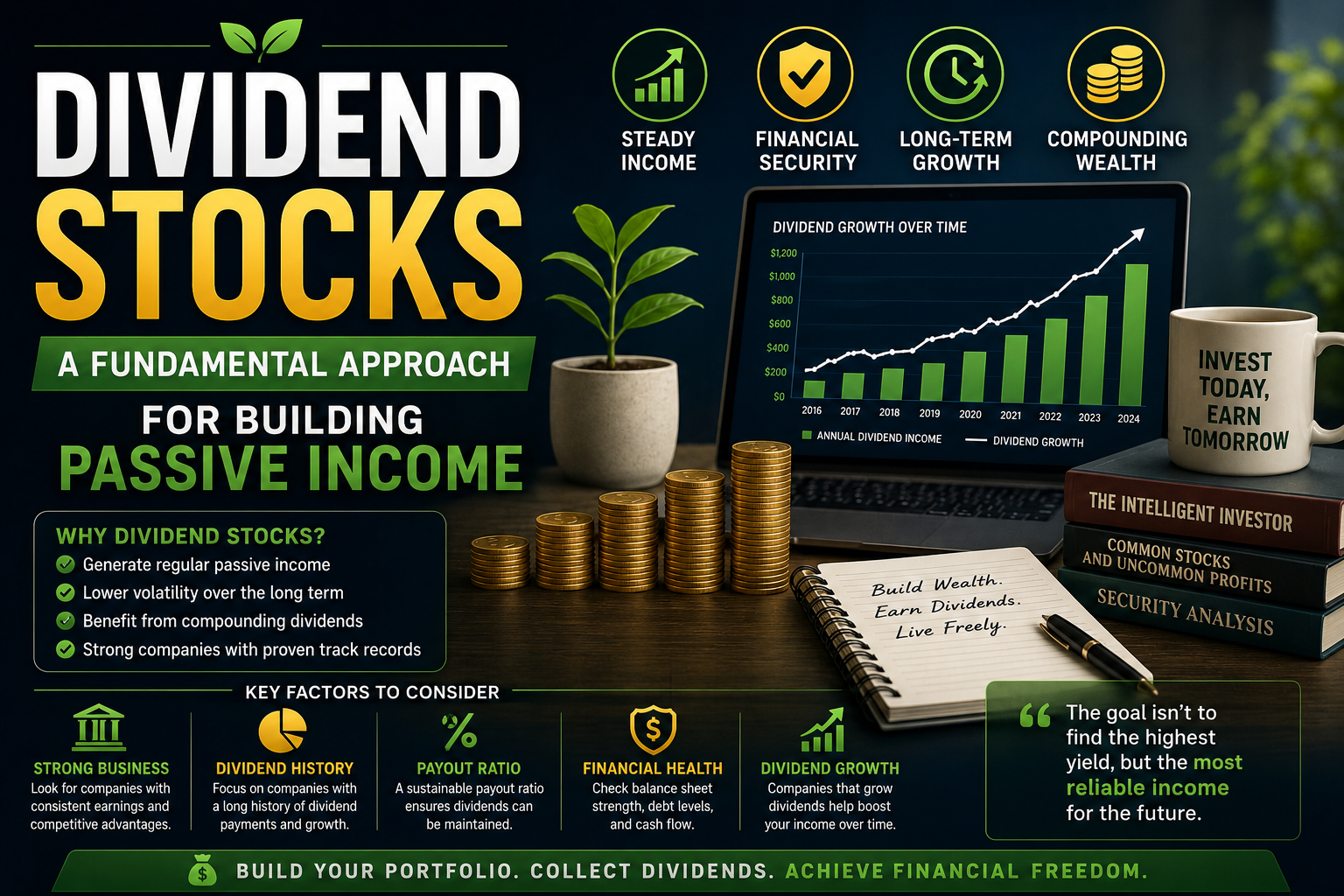
Dividend stocks offer one of the most reliable paths to building long-term passive income. Instead of relying solely on price appreciation, investors in dividend stocks receive regular cash payments directly into their brokerage account — essentially getting paid to own quality businesses.
In this guide, we’ll explore a fundamental analysis approach to selecting strong dividend stocks, key metrics to watch, how to build a sustainable dividend portfolio, and important risks to consider.
Important Disclaimer: Investing in stocks involves substantial risk of loss and is not suitable for everyone. This article is for educational purposes only and does not constitute financial advice. Always do your own research or consult a licensed financial advisor.
My Personal Perspective: The Hard Reality and Dedication Behind Building a Dividend Portfolio
If I’m being entirely honest, trying to build a serious dividend portfolio is a humbling experience. It requires a level of patience, continuous capital inflow, and deep fundamental research that many people don’t realize upfront. When you look online, you see people talking about living entirely off their dividend income like it’s a simple passive dream. But the reality is that to reach that level, you need a substantial starting capital base, steady income to fund your purchases over years, and the discipline to dig deep into balance sheets, cash flows, and business models so you don’t get trapped by a sudden dividend cut.
From my own attempts at building and managing a portfolio, I’ve learned that dividend investing is very similar to active investing in terms of the research required—you can’t just pick a high-yield stock at random and hope for the best. While there certainly are people out there who successfully earn their living exclusively from dividends, getting to that point takes immense dedication, rigorous due diligence, and a long-term commitment. It’s a fantastic wealth-building strategy, but it’s definitely not a set-it-and-forget-quick scheme.
What Are Dividend Stocks?
Dividend stocks are shares of companies that distribute a portion of their profits to shareholders on a regular basis (usually quarterly). These companies are typically mature, stable, and generate consistent cash flow.
Types of Dividend Stocks:
- Dividend Aristocrats: Companies that have increased dividends for 25+ consecutive years
- Dividend Kings: 50+ years of dividend increases
- High-Yield Dividend Stocks: Higher current yield but potentially higher risk
- Dividend Growth Stocks: Lower current yield but fast-growing payouts
Benefits of Dividend Investing for Passive Income
- Regular Cash Flow: Create income without selling shares
- Compounding Power: Reinvesting dividends accelerates growth over time
- Lower Volatility: Dividend-paying companies tend to be more stable
- Inflation Hedge: Many strong dividend companies raise payouts over time
- Tax Advantages: In many countries, qualified dividends are taxed at lower rates
Key Fundamental Metrics for Dividend Stocks
When evaluating dividend stocks, focus on quality and sustainability rather than just chasing the highest yield.
1. Dividend Yield
Formula: Annual Dividend per Share ÷ Stock Price
- Good range: 2–6% (above 8% often signals higher risk)
2. Dividend Payout Ratio
Formula: Dividends Paid ÷ Net Income
- Ideal: 40–60% for most companies (leaves room for growth)
- Above 80% may be unsustainable
3. Dividend Growth Rate
Look for companies that consistently increase dividends 5–15% per year.
4. Free Cash Flow (FCF)
Strong and growing FCF ensures the company can comfortably afford dividend payments.
5. Debt-to-Equity Ratio
Lower debt levels (under 1.0) indicate better financial health for long-term dividend sustainability.
6. Earnings Per Share (EPS) Growth
Consistent EPS growth supports future dividend increases.
Dividend Stock Selection Criteria (Fundamental Checklist)
- Strong competitive advantage (economic moat)
- Consistent earnings and revenue growth
- Healthy balance sheet (reasonable debt)
- Long history of dividend payments and increases
- Reasonable valuation (P/E ratio in line with growth rate)
- Strong free cash flow coverage
Building a Dividend Portfolio Strategy
The Dividend Growth Investing Approach (Recommended):
- Focus on quality over high yield
- Diversify across 15–30 stocks in different sectors
- Reinvest dividends in the early years
- Increase positions during market pullbacks
Sample Portfolio Allocation:
- Consumer Staples: 20%
- Healthcare: 15%
- Industrials: 15%
- Technology: 15%
- Financials: 15%
- Energy/Utilities: 10%
- Others: 10%
Real-World Examples
Example 1: Procter & Gamble (PG) A classic Dividend King with over 65 years of increases. Stable demand for everyday products, strong brand moat, consistent EPS growth, and a healthy payout ratio around 55–60%.
Example 2: Johnson & Johnson (JNJ) Healthcare giant with a long dividend growth history and strong cash flow making it a core holding for many income investors.
Example 3: Microsoft (MSFT) Modern dividend growth story. While the yield is lower, Microsoft has rapidly grown its dividend while maintaining a strong balance sheet.
Risks of Dividend Investing
- Dividend Cuts: Companies can reduce or eliminate dividends during financial distress
- Opportunity Cost: High-yield stocks may underperform growth stocks in bull markets
- Interest Rate Sensitivity: Rising rates can make bonds more attractive, pressuring dividend stock prices
- Inflation Risk: If dividends don’t grow faster than inflation, purchasing power erodes
- Sector Concentration Risk: Many high-yield stocks are concentrated in energy, utilities, or REITs
Common Mistakes Beginners Make
- Chasing the highest dividend yield without checking underlying business sustainability
- Ignoring payout ratios and free cash flow coverage
- Lack of proper portfolio diversification
- Selling during market dips instead of buying more quality assets
- Focusing only on yield instead of total return
Key Takeaways
- Dividend stocks are an excellent vehicle for building sustainable passive income through a fundamental approach, but they require serious research and dedication.
- Prioritize dividend growth and quality over chasing high current yields.
- Focus heavily on key metrics: payout ratio, free cash flow, earnings growth, and debt levels.
- Combine fundamental analysis with technical tools for better entry timing—such as buying near support levels or during pullbacks.
- Be patient and consistent. Reinvest dividends early on to harness the true power of compounding.