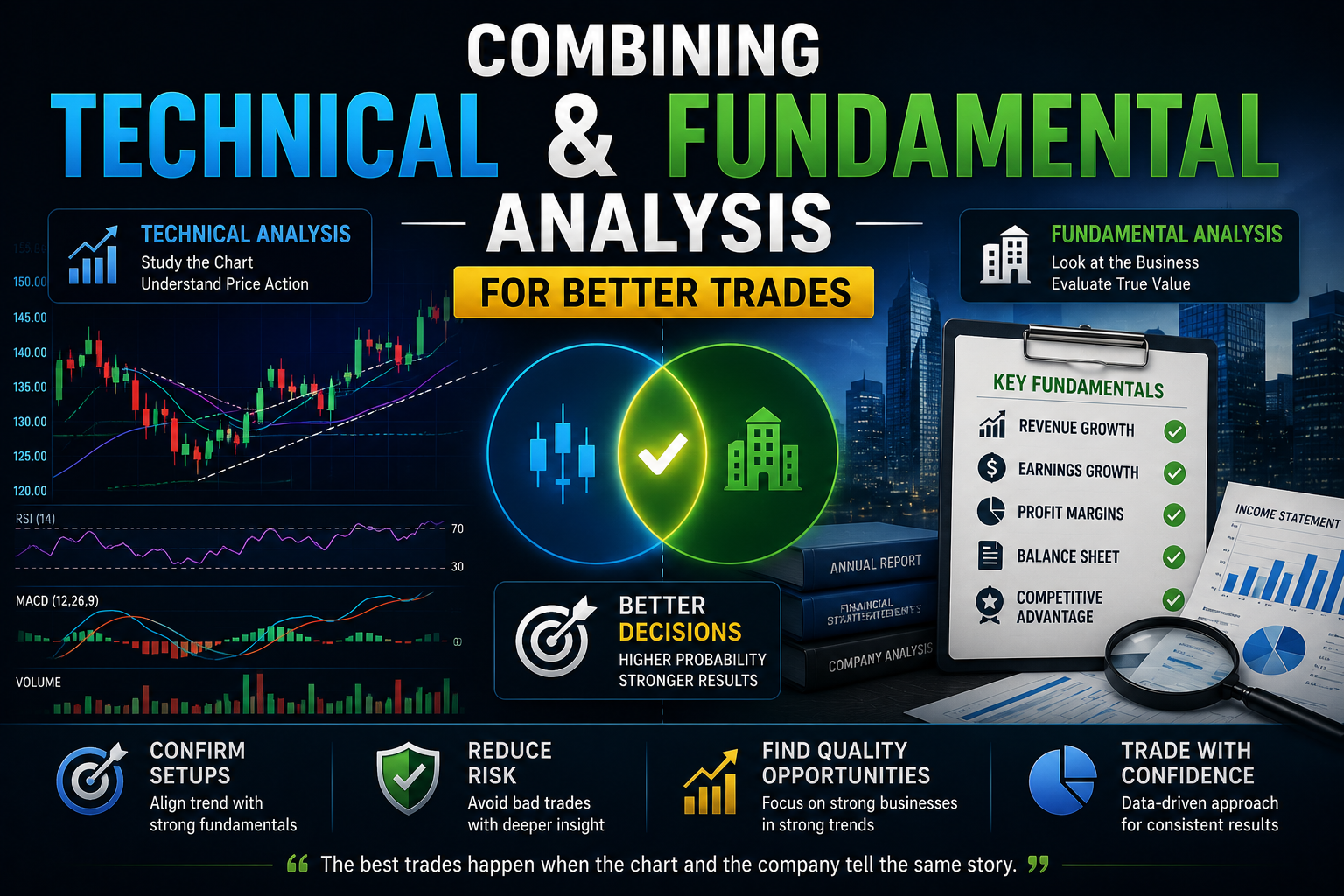
People pick a camp: “only price” or “only numbers.” I use a dull split.
Fundamentals tell me when the story can change.
Technicals tell me where I am wrong if I am already in.
I do not mix them into a smoothie so every trade has both stamps. That is how you justify anything.
How I actually combine them
1. Map the week on price first. Sunday map.
2. Look at the calendar. If a print or earnings date sits inside the hold time, pick a news mode. [News-day rules](https://traderslook.com/).
3. If I have no calendar risk, the trade is a price trade. I do not invent a “fundamental overlay” to feel smarter.
4. If I am holding through an event on purpose, size is already cut. FA did not pick the entry. It only changed size.
A stock example, as illustration
Earnings Thursday. Daily trend intact, invalidation is last week’s low.
– Mode A (sit): I want the reaction after the print, not the guess.
– Mode B (hold smaller): I already had the swing, I accept gap risk with less size.
– Mode C (flatten): the trade was only a two-day idea.
None of those is “fundamentals say buy.” All of them are process.
What I do not do
– Average a P/E with an RSI and call it confluence
– Trade a weak chart because the story is good
– Ignore a scheduled event because the pattern is pretty
The longer 101s on this site still exist if you need definitions: TA vs FA, earnings, economic prints. This page is only the handshake between them.
Price still gets the stop. The calendar gets a veto or a size cut. That is the whole combination.
The Two Pillars of Market Analysis
Before we look at how to merge them, let’s briefly define what each pillar brings to the table.
1. Fundamental Analysis: The “What” and “Why”
Fundamental analysis is the study of the underlying forces that affect the economy, industrial sectors, and individual companies or assets. Its ultimate goal is to determine the intrinsic value of an asset to see if it is currently underpriced (a buying opportunity) or overpriced (a selling opportunity).
- In Stocks: This includes looking at revenue, profit margins, Earnings Per Share (EPS), debt-to-equity ratios, macroeconomic interest rates, and management strength.
- In Crypto: This involves evaluating network utility, tokenomics, developer activity, total value locked (TVL), and active wallet addresses.
- In Forex: This means tracking GDP growth, employment data, central bank monetary policy, and inflation rates.
Fundamentals give you conviction. They help you find high-quality assets that have a strong structural reason to move higher over time.
2. Technical Analysis: The “When” and “Where”
Technical analysis completely ignores intrinsic value. Instead, it focuses entirely on market psychology, price action, and volume. Technical analysts study historical charts because human psychology repeats itself, creating predictable patterns.
- Tools Used: Candlestick patterns, support and resistance lines, moving averages (like the SMA or EMA), Volume Weighted Average Price (VWAP), and momentum oscillators (like the RSI).
Technicals give you execution accuracy. They prevent you from buying an amazing asset right before a major technical correction, and they show you exactly where to place your stop-loss to manage your risk.
The Step-by-Step Hybrid Trading Framework
Here is a practical, step-by-step workflow you can use to combine both disciplines into a singular trading strategy.
Step 1: Filter the Market Using Fundamentals
Start your week by looking for assets that have a clear fundamental catalyst or a structural imbalance in value. You want to answer the question: Which assets have the wind at their back?
- Look for Fundamental Catalysts: Is a company about to report earnings that are expected to beat expectations? Is a cryptocurrency undergoing a major network upgrade that reduces supply? Is a central bank cutting interest rates, which historically pumps liquidity into that specific currency’s stock market?
- Build Your Watchlist: Filter out the noise. If an asset has messy fundamentals, declining revenue, or heavy regulatory headwinds, keep it off your list—no matter how enticing the chart looks.
Step 2: Locate Key Technical Levels
Once you have your fundamental watchlist (e.g., three high-growth stocks or highly utilized commodities), open up your charting platform. Your goal now is to wait patiently for price action to align with your fundamental thesis.
- Find the Trend: Ensure the technical trend matches the fundamental bias. If your fundamental research says an asset should go up, make sure the price is trading above its 50-period or 200-period moving average. Never fight a strong technical markdown, even if you love the fundamentals.
- Identify Support Zones: Do not chase a stock when it is breaking out into vertical “FOMO” runs. Wait for a healthy technical pullback to a major daily support level, a trendline, or a dynamic indicator like the VWAP.
Step 3: Identify the Technical Trigger
Now that the fundamentally strong asset has pulled back to a key technical support level, you look for a validation trigger to execute the trade.
- Look for Reversal Candles: Watch for bullish price action signals, such as a hammer candlestick, a bullish engulfing pattern, or a sudden surge in buying volume at the support line. This proves that the market’s big institutional players are stepping in to defend that price level.
- Execute with Precise Risk Management: Because you are using technicals, you don’t have to guess where to exit if you are wrong. Place your stop-loss right below the technical support level. If the fundamentals are strong but the technical level breaks, the market is telling you that your timing is off, and it’s safer to step aside.
Real-World Example: The Corporate Earnings Play
Let’s look at how this looks in practice during a corporate earnings season:
- The Fundamental Catalyst: Company XYZ reports spectacular quarterly earnings, beating Wall Street estimates by 15%, and raises its financial guidance for the rest of the year. The stock gaps up aggressively on high volume.
- The Technical Patience: Instead of buying the opening gap-up at an overextended price, the hybrid trader waits. Over the next week, short-term traders take their profits, causing the stock price to slowly drift downward.
- The Convergence: The stock drifts down until it perfectly touches its upward-sloping 20-day Exponential Moving Average (EMA), which happens to align with the price level of the original earnings gap.
- The Trade: The trader spots a bullish rejection candle at the 20-day EMA. The fundamental story hasn’t changed (the company is still highly profitable), but the technical risk-to-reward ratio is now perfect. The trader enters long, placing a tight stop-loss just underneath the moving average.
Conclusion: The Complete Trader
Relying solely on charts leaves you vulnerable to unexpected macroeconomic shocks, news events, and systemic market shifts. Relying solely on balance sheets leaves you vulnerable to terrible market timing, agonizing drawdowns, and capital inefficiency.
When you combine technical and fundamental analysis, you stop guessing. You gain the macroeconomic confidence required to hold through normal market volatility, combined with the surgical precision needed to protect your account balance when a trade goes invalid. Treat fundamentals as your compass and technicals as your radar—using both is how you truly master the market.
Disclaimer: Content on traderslook.com is for educational and informational purposes only and should not be construed as professional financial advice.