If you ask a room of retail day traders how they plan to make money, most will talk about predicting the next market bottom, catching a fast breakout, or using complex indicators to find a reversal. They want to be right, and they want to be fast.
But what if the secret to making millions in the market has absolutely nothing to do with predicting the future?
This is the core premise of Michael Covel’s seminal book, Trend Following: How to Make a Fortune in Bull, Bear, and Black Swan Markets. Covel argues that trying to guess where an asset’s price will go is a fool’s errand. Instead, the most profitable traders in history don’t predict—they react. They find a powerful trend that is already moving, hop on for the ride, and ride it until the trend bends.
This review breaks down the core philosophies of Covel’s work, dissects the famous “Turtle Trading System” highlighted in the book, and provides practical ways to apply trend following to your own trading dashboard today.

The Philosophy of Trend Following: Forget the “Why”
Michael Covel builds his entire book around a single, liberating truth: The price is the only thing that matters.
Traditional fundamental analysts spend hundreds of hours looking at balance sheets, macroeconomic reports, and corporate management teams to figure out why a stock should move. Covel completely discards this. He argues that all of that information is already baked into the current market price.
A Trend Follower doesn’t care why Bitcoin is going up, or why crude oil is crashing. They only care that it is happening.
The Core Pillars of the Strategy
- Accepting the Lag: Trend following is inherently a lagging strategy. You will never buy the exact bottom, and you will never sell the exact top. The goal is simply to capture the massive middle 60% to 70% of a macro market move.
- Cutting Losses Instantly: Because you are buying breakouts, many of your trades will be “whipsaws” (false breakouts). Covel emphasizes that trend followers accept a low win rate (often only 35% to 40%), but their winning trades are so massive that they completely wipe out the small, controlled losses.
- Letting Winners Run: The psychological urge to lock in a quick profit is the biggest enemy of a trader. Covel teaches that you must stay in a winning trade until the market’s structure explicitly proves the trend has ended.
The Legendary System: The Turtle Traders
One of the most fascinating segments of Covel’s book covers the history of the Turtle Traders—an experiment conducted in the 1980s by legendary commodities traders Richard Dennis and William Eckhardt.
Dennis believed that anyone could be taught to trade successfully if given a strict, rule-based system. Eckhardt disagreed, believing trading talent was innate. To settle the bet, they recruited a group of regular people (the “Turtles”), gave them a set of rules, handed them millions of dollars of trading capital, and watched them generate over $175 million in profits in just a few years.
The Turtle System was a pure, mechanical trend-following model. While the book covers the history deeply, the system boils down to four strict, rules-based questions.
1. The Entry (Donchian Channels)
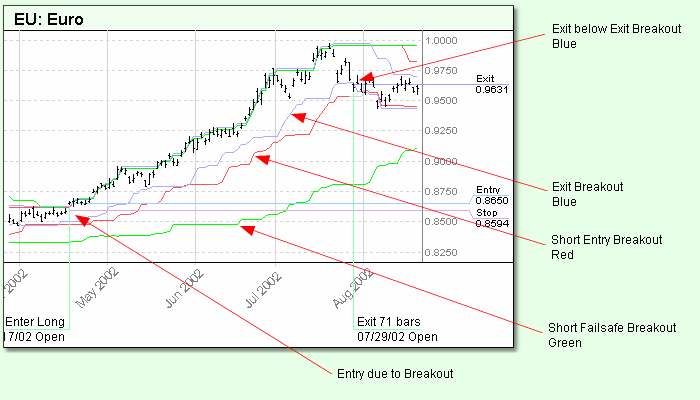
The Turtles used a technical indicator called Donchian Channels to measure breakouts. A Donchian Channel simply plots the highest high and the lowest low over a set period.
- System 1 (Short-term): Buy a breakout if the price moves above the highest high of the last 20 days. Short an asset if the price falls below the lowest low of the last 20 days.
- System 2 (Long-term): Buy a breakout if the price moves above the highest high of the last 55 days.
2. Position Sizing (The “N” Variable)
The Turtles didn’t just guess how many shares or contracts to buy. They normalized their risk based on market volatility using a variable called N, which is equivalent to the Average True Range (ATR).
- If a market was highly volatile (high N), they bought a very small position.
- If a market was quiet and stable (low N), they bought a much larger position.
- This ensured that a 1% move in a volatile asset like crude oil had the exact same dollar impact on their account balance as a 1% move in a stable asset like a government bond.
3. The Stop-Loss
The system had a non-negotiable exit if the trade went wrong. The stop-loss was strictly set at 2N (two times the ATR) below their entry price. If the asset dropped past that point, the trade was immediately closed. No hoping, no waiting for a bounce, no emotional hesitation.
4. The Exit (Taking Profit)
To catch massive trends, you have to give the asset room to breathe. The Turtles did not use static profit targets. Instead, they only exited a long trade when the price dropped below a 10-day low (for System 1) or a 20-day low (for System 2). This meant they often watched a portion of their open profits evaporate before exiting, but it guaranteed they never cut a multi-month trend short.
My Personal Experience: Why I Moved Away from the Turtle System
When I first came across the Turtle Trading System, I was fascinated. The idea of a completely mechanical, emotionless framework that could generate millions sounded like the holy grail. I actually took the time to test and trade this system out myself. While the logic is brilliant and the math behind the Average True Range and Donchian channel breakouts is entirely sound, I ultimately found that it just wasn’t the right fit for my trading style.
The sheer number of false breakouts and the prolonged periods of choppy, sideways chop can test your mental endurance to the absolute limit. Sitting through low win rates while waiting for that elusive macro home run requires a very specific psychological makeup. Over time, I realized I prefer a more direct, hands-on approach. Today, I much prefer to stick to clean price action combined with Fibonacci support and resistance levels. Giving up rigid automated channel trading for structural price action lets me read market psychology in real time, manage my risk with precision, and spot exact turning points without waiting for lagging channel indicators to catch up.
Key Takeaways for Today’s Traders
While the original Turtle System was designed for the commodities markets of the 1980s, Covel’s Trend Following remains incredibly relevant for modern stock, forex, and cryptocurrency markets. Here is how you can apply the book’s wisdom to a 21st-century dashboard:
- Implement Trailing Stops: Stop using fixed take-profit orders. If you are in an uptrend, use an indicator like the Average True Range (ATR) or a long-term Exponential Moving Average (like the 50-period EMA) to trail your stop-loss upward as the price climbs.
- Diversify Your Watchlist: Trend following relies on a few “home run” trades to make its money. If you only trade one stock, you might sit through months of sideways, unprofitable choppy action. To fix this, apply your trend-following system across multiple asset classes—stocks, commodities, and crypto—so you maximize your chances of catching a massive structural trend somewhere in the global economy.
- Embrace the Losing Streak: Covel’s book is a masterclass in trading psychology. It teaches you to reframe how you look at losing trades. In a trend-following system, a loss isn’t a mistake; it is simply the “cost of doing business” to find the next 500% winner.
Conclusion: A Masterclass in Systematic Discipline
Michael Covel’s Trend Following is not a book for day traders looking for action and excitement. It is a blueprint for systematic, rule-based investors who want to treat trading like an insurance business or a casino—relying on a statistical edge over a long period.
By stripping away the noise of the news cycle, earnings gossip, and fundamental predictions, Covel teaches us to respect the chart, manage our risk mathematically, and let the market do the heavy lifting. It is an absolute must-read for any trader looking to step away from emotional gambling and move toward systematic profitability.
Disclaimer: Content on traderslook.com is for educational and informational purposes only and should not be construed as professional financial advice.