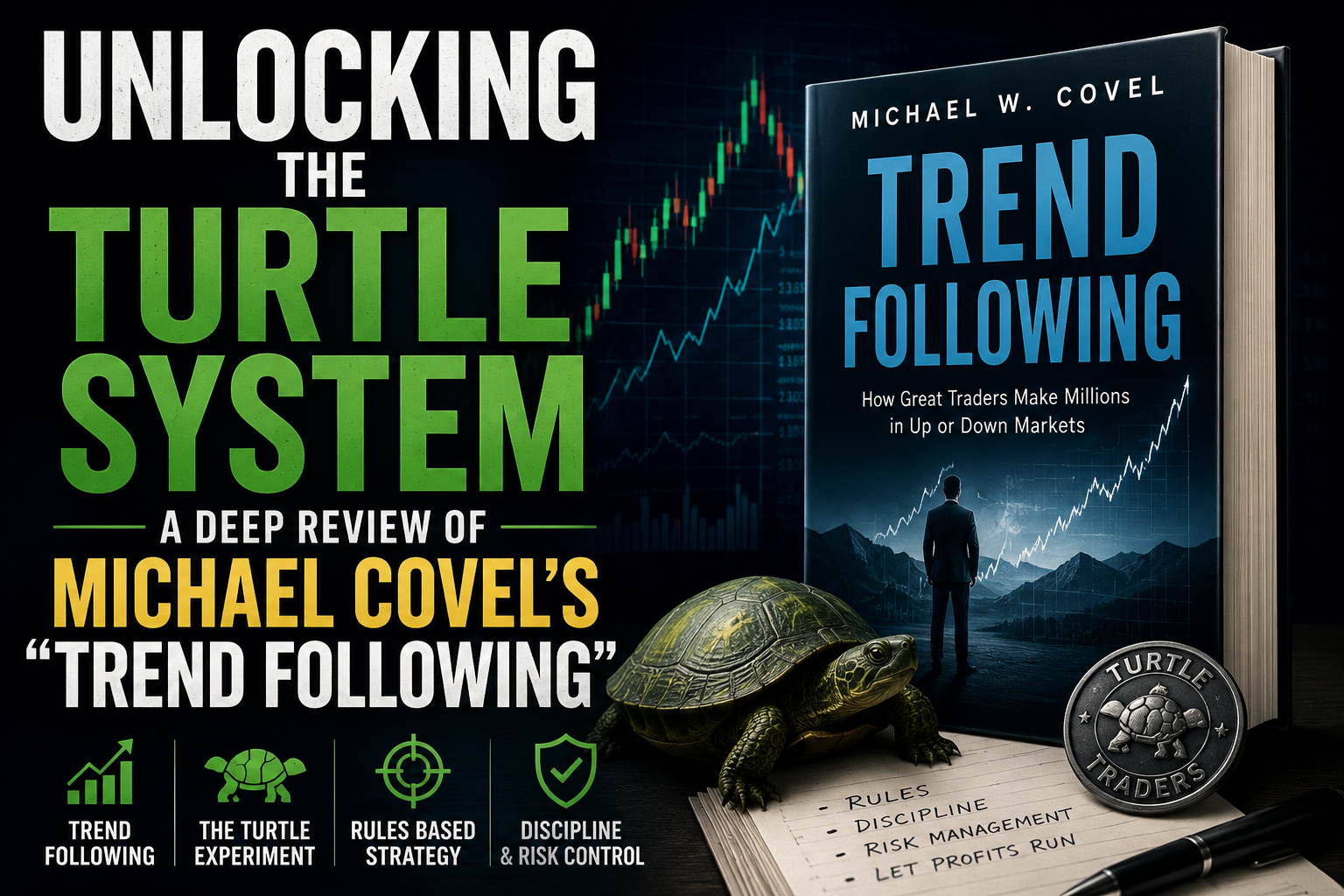
Michael Covel’s *Trend Following* is not a magic book. The useful part is blunt: most of the money in those systems sits in a few large trends, and the rest of the time you pay for the wait.
I do not run a full Turtle clone. I stole three ideas and rejected the rest.
What I kept
1. Risk first, then the breakout
The original classroom story is famous because of size rules, not because of a sacred number of days. If I cannot state risk before I care about the Donchian lookback, I am reading the book backward. Risk.
2. The market can stay quiet longer than my patience
Trend following feels stupid in a range. That is the point. If I cannot stand a streak of small losers, I should not pretend I want the outlier win.
3. Rules on paper beat opinions on forums
A written entry, a written exit, a written no-trade list. Same as the plan.
The Philosophy of Trend Following: Forget the “Why”
Michael Covel builds his entire book around a single, liberating truth: The price is the only thing that matters.
Traditional fundamental analysts spend hundreds of hours looking at balance sheets, macroeconomic reports, and corporate management teams to figure out why a stock should move. Covel completely discards this. He argues that all of that information is already baked into the current market price.
A Trend Follower doesn’t care why Bitcoin is going up, or why crude oil is crashing. They only care that it is happening.
The Core Pillars of the Strategy
- Accepting the Lag: Trend following is inherently a lagging strategy. You will never buy the exact bottom, and you will never sell the exact top. The goal is simply to capture the massive middle 60% to 70% of a macro market move.
- Cutting Losses Instantly: Because you are buying breakouts, many of your trades will be “whipsaws” (false breakouts). Covel emphasizes that trend followers accept a low win rate (often only 35% to 40%), but their winning trades are so massive that they completely wipe out the small, controlled losses.
- Letting Winners Run: The psychological urge to lock in a quick profit is the biggest enemy of a trader. Covel teaches that you must stay in a winning trade until the market’s structure explicitly proves the trend has ended.
What I rejected
– Copying 1980s futures size into a small retail account
– Adding every market on earth because “diversification”
– Treating a 20-day breakout as holy. Lookbacks are parameters. Parameters get fitted if you fidget
– The implied promise that reading the book produces Turtle-like results. It does not. Different costs, different markets, different stomach
How I would test a piece of it, if I cared enough
One market. One breakout definition. Stops beyond the range that defined the entry. Reduced size for 20 live trades after a historical pass. Backtest notes and first 20.
If I start adding filters after every loser, I am no longer testing trend following. I am building a new system and blaming Covel.
Who this is not for
If you need action every session, this family of methods will make you miserable and then sloppy. Trade a style that matches your hours instead of a legend. Day vs swing.
This is a reading note and a filter, not a recommendation to buy the book or to trade breakouts. Markets change. Books do not manage your risk for you.