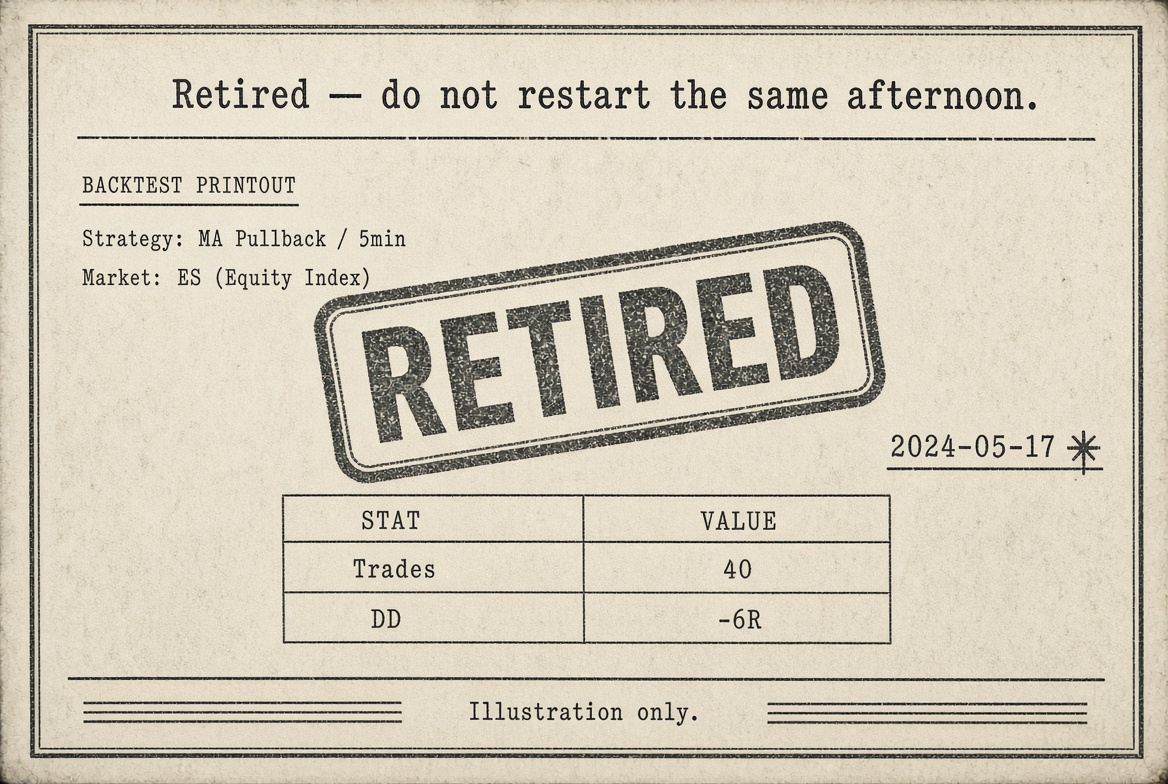
I used to retire methods only after they hurt. That is late.
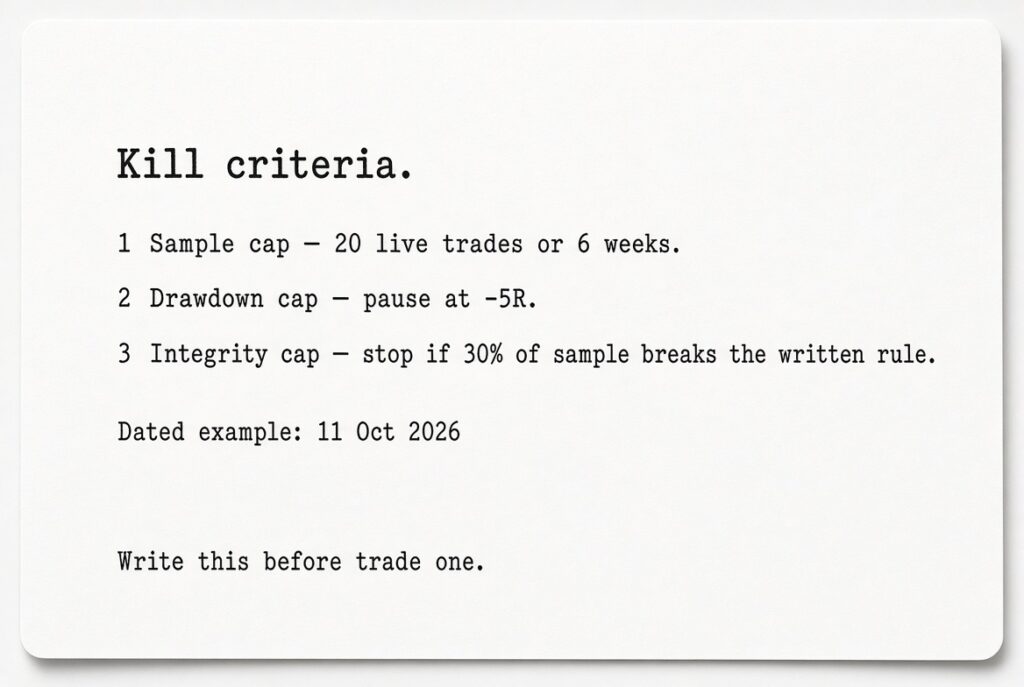
An idea should have a death date and a death number before trade one. Otherwise I will keep tweaking the stop until the backtest smiles again. That loop is described in the backtesting blueprint. This note is the off switch.
The three kill lines I write first
1. Sample cap
Twenty live trades at reduced size, or six weeks, whichever comes first. When the cap hits, I decide. I do not quietly start trade 21 at full size.
2. Drawdown cap
If the live sample is down 5R, the test pauses. Pause means no new tickets under that rule, not “I will be more selective.”
3. Integrity cap
If I break the written rule on 30% of the sample, the method is not on trial. I am. I stop the method until I can follow a simpler rule for ten trades.
Any one of the three is enough.
What is not a kill
– Two losers in a row
– A week of boredom
– A YouTube video that says the method is dead
– A winner that would have been larger with a different stop
Those are moods. Moods do not get to edit the spec.
What I do when a method dies
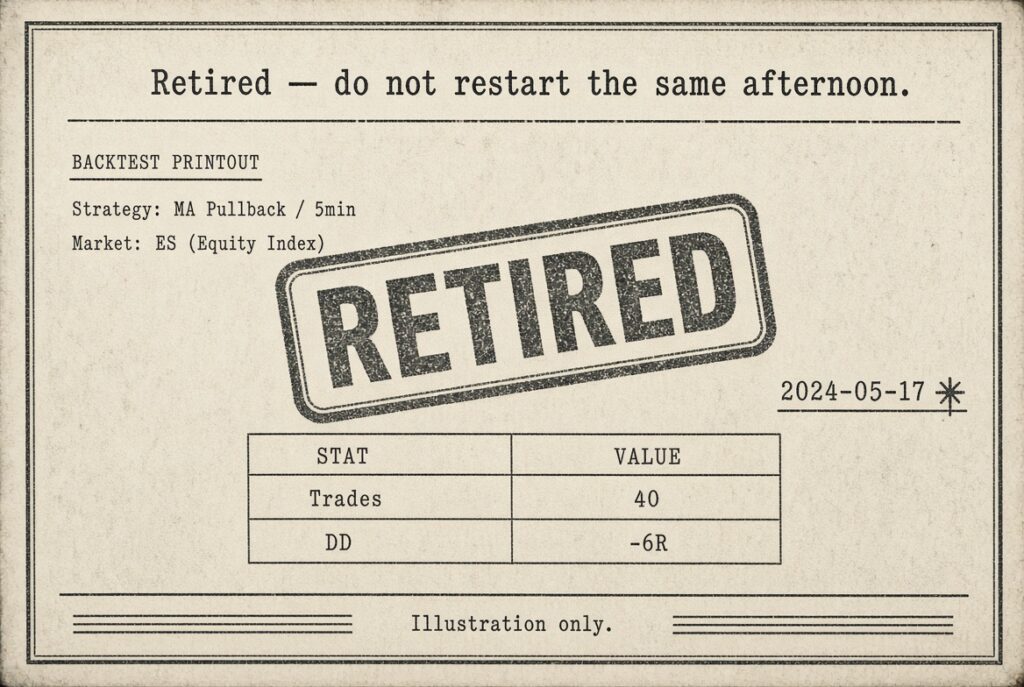
I label the journal page “retired” and the date. I do not delete the notes. I need to see that I already tried this variation last quarter.
Then I go back to the methods that still have a pulse: the plan, the risk unit, the weekly map.
I do not replace a killed idea the same afternoon. Replacement-the-same-day is how accounts collect unfinished systems.
A useful sentence
“This was a test. The test ended.”
Say it when the number hits, not after you have already doubled the size to get even.
If you cannot write kill criteria for an idea, you do not have a strategy. You have a hope with a chart attached. Hope does not get a live bid.