
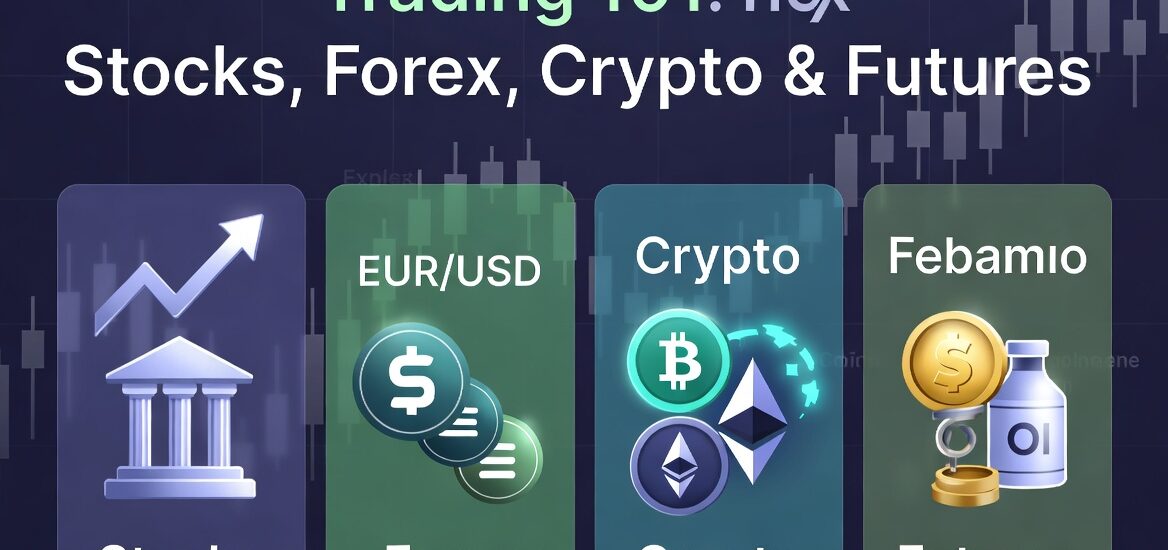
Trading can be an exciting way to participate in financial markets, but it also comes with significant risks. Whether you’re looking to build long-term wealth or generate short-term income, understanding the different markets is the essential first step.
In this beginner-friendly guide, we’ll break down the four major trading markets — Stocks, Forex, Crypto, and Futures — their key characteristics, main differences, and which one might be the best starting point for new traders.
Important Disclaimer: Trading involves substantial risk of loss and is not suitable for everyone. Past performance does not guarantee future results. Always trade with money you can afford to lose and consider consulting a licensed financial advisor.
1. Stocks (Equity Trading)
Stocks represent ownership shares in publicly listed companies. When you buy a stock, you own a small piece of that company.
Key Features:
- Traded on stock exchanges (NYSE, NASDAQ, etc.)
- Trading hours are generally limited (e.g., 9:30 AM – 4:00 PM ET for US markets)
- Influenced by company performance, earnings reports, industry news, and overall economy
- Can generate income through price appreciation and dividends
Best For: Investors who want to own real businesses and potentially benefit from long-term growth. Popular among beginners due to familiarity with company names (Apple, Tesla, Amazon, etc.).
Pros: High transparency, strong regulation, potential dividend income. Cons: Requires more capital to start meaningfully, markets close at night.
2. Forex (Foreign Exchange)
Forex is the largest financial market in the world, where currencies are traded in pairs (e.g., EUR/USD, GBP/JPY).
Key Features:
- Operates 24 hours a day, 5 days a week
- Extremely high liquidity
- Traded in “lots” with high leverage (which increases both potential profit and loss)
- Driven by economic data, interest rates, geopolitical events, and central bank policies
Best For: Traders who prefer fast-moving markets and want flexibility to trade at any time.
Pros: Lowest entry barrier (can start with small accounts), high liquidity. Cons: High leverage can lead to rapid losses, complex macroeconomic factors.
3. Cryptocurrency
Crypto trading involves digital assets like Bitcoin, Ethereum, and thousands of altcoins.
Key Features:
- Trades 24/7 with no market close
- Extremely volatile — prices can swing 10%+ in a single day
- Decentralized nature with less regulation (though this is changing)
- Influenced by news, adoption, regulation, and market sentiment
Best For: Tech-savvy traders comfortable with high risk and innovation.
Pros: Very low entry cost, exciting potential upside, 24/7 access. Cons: High volatility, security risks (hacks, scams), regulatory uncertainty.
4. Futures
Futures are standardized contracts to buy or sell an asset (commodities, indices, currencies, etc.) at a predetermined price on a specific future date.
Key Features:
- Traded on regulated exchanges (CME, etc.)
- High leverage available
- Includes commodities (oil, gold), stock indices (S&P 500), and more
- Used for both hedging and speculation
Best For: Experienced traders who want exposure to commodities or prefer trading indices without owning stocks.
Pros: Excellent liquidity in major contracts, transparent pricing. Cons: Expiration dates add complexity, can require larger account sizes.
Key Differences at a Glance
| Market | Trading Hours | Volatility | Leverage | Regulation | Best For | Starting Capital |
|---|---|---|---|---|---|---|
| Stocks | Limited | Medium | Low | High | Long-term investors | Medium |
| Forex | 24/5 | Medium | Very High | High | Flexible short-term | Low |
| Crypto | 24/7 | Very High | High | Medium | High-risk appetite | Very Low |
| Futures | Extended | High | High | High | Advanced traders | Medium-High |
Which Market Should You Start With?
Recommendation for most beginners: Start with Stocks.
Stocks are generally the easiest to understand because you’re buying real companies you already know. The market moves slower than Forex or Crypto, and there’s a wealth of educational resources and strong investor protections.
Once you’re comfortable with stocks and risk management:
- Move to Forex if you want more trading time and technical analysis focus.
- Try Crypto only if you have high risk tolerance and are prepared for big swings.
- Explore Futures after gaining significant experience due to complexity and leverage.
Pro Tip: No matter which market you choose, focus first on risk management (never risk more than 1-2% of your account on a single trade) and practice on a demo account.
Trading is a skill that takes time to develop. The best traders combine knowledge of different markets with strong psychology and discipline.
Start small, stay consistent, and treat your first year primarily as education rather than profit hunting.
