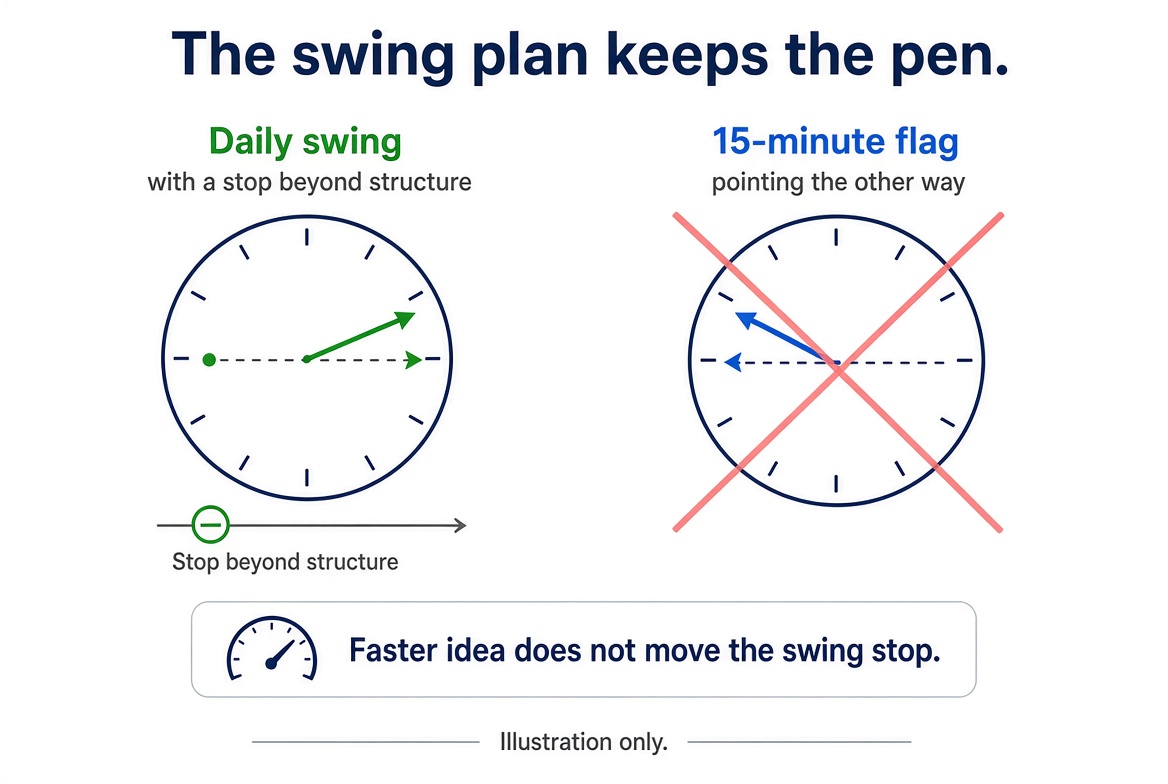
Swing trading is still the default. Faster trades are a study, not a second job that outranks the first.
The conflict shows up on ordinary days. A daily long is valid. A 15-minute flag breaks the other way. If I flatten the swing to “catch” the fast move, I did not adapt. I broke the plan because a smaller clock was louder.
The rule I am using while I learn the faster tempo
- A swing already on the book keeps its invalidation. A day-trade idea does not move that stop.
- A new intraday idea is allowed only if it does not need me to be flat the swing to “make room.”
- If I want the fast trade badly enough to edit the swing, I pass on the fast trade.
- Intraday experiments stay at half the normal risk, same as any new idea in its first sample.
That is the whole bridge between the two styles. The longer version of why the styles should not be mixed in one session is on the day versus swing page.
What “exploring” is allowed to mean
I can mark an opening range. I can journal a pass. I can take a small session trade in the same direction as the swing, with its own stop, after the open has printed.
I cannot:
- turn a swing into a scalp because the first 15 minutes were exciting
- add a sixth name because the five on the watchlist are quiet
- call a revenge scalp “research” after the daily cap is hit
One line in the journal
If both clocks were open, the row needs a style tag: swing or session. A winner with no tag is an F-grade even if it paid. I will not know in a month which experiment I am actually running.
Faster is not more professional. It is a different hold time. Until the sample is done, the swing plan keeps the pen.