n
Introduction
When it comes to fundamental analysis and long-term investing, two of the most popular approaches are Value Investing and Growth Investing. Understanding the differences between them will help you choose a style that fits your personality, risk tolerance, and goals.
In this guide, we’ll break down what each strategy is, the key metrics investors look for, their pros and cons, and when to use one over the other — or combine both.
Important Disclaimer: Trading and investing involve substantial risk of loss and is not suitable for everyone. This article is for educational purposes only and does not constitute financial advice.
What is Value Investing?
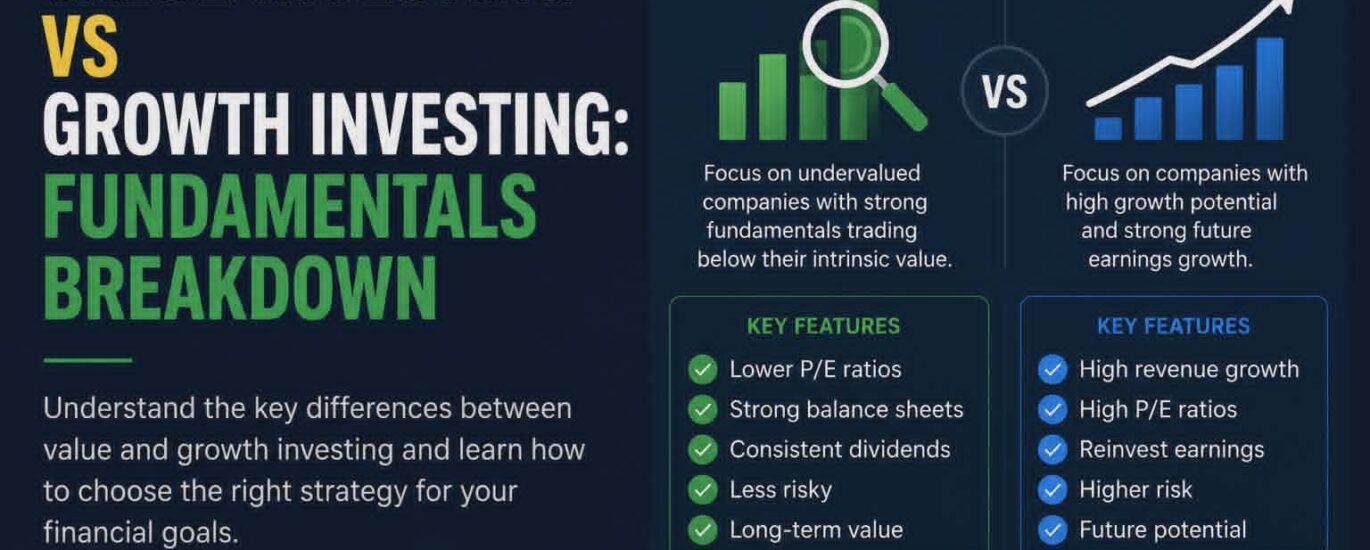
Value investing is the strategy of buying stocks that appear to be trading below their intrinsic (true) value. Value investors believe the market sometimes overreacts to news, creating buying opportunities in high-quality companies at discounted prices.
Key Characteristics:
- Focus on undervalued companies
- Buy low, sell when the market recognizes the true value
- Long-term holding period (often years)
Core Metrics Value Investors Watch:
- Low Price-to-Earnings (P/E) ratio
- Low Price-to-Book (P/B) ratio
- High Dividend Yield
- Strong Free Cash Flow
- Low Debt-to-Equity
- Margin of Safety (buying at a significant discount to intrinsic value)
Famous value investors include Warren Buffett, Benjamin Graham, and Seth Klarman.
What is Growth Investing?
Growth investing focuses on companies expected to grow earnings, revenue, and market share significantly faster than the overall market — even if their current valuations appear expensive.
Key Characteristics:
- High growth potential (often in technology, healthcare, or emerging sectors)
- Willing to pay a premium for future growth
- Can deliver massive returns when successful
Core Metrics Growth Investors Watch:
- High EPS and Revenue Growth Rates (20%+ YoY)
- Expanding profit margins
- Strong Return on Equity (ROE)
- Innovative products or services with competitive advantages (moats)
- Market leadership in growing industries
Famous growth investors include Philip Fisher and many modern tech-focused fund managers.
Value vs Growth Investing: Detailed Comparison
| Aspect | Value Investing | Growth Investing |
|---|---|---|
| Valuation | Cheap (low P/E, P/B) | Premium (high P/E) |
| Focus | Current undervaluation | Future earnings growth |
| Time Horizon | Long-term (3–10+ years) | Medium to long-term |
| Risk Profile | Lower (margin of safety) | Higher (growth can disappoint) |
| Market Conditions | Performs well in bear/recovery markets | Performs well in bull/expansion markets |
| Key Risk | Value traps (cheap for a reason) | Overpaying for growth that never comes |
| Typical Sectors | Financials, Energy, Consumer Staples | Technology, Consumer Discretionary, Healthcare |
Pros and Cons
Value Investing Pros:
- Built-in margin of safety
- Lower volatility
- Dividends provide income during waiting periods
- Strong long-term track record when done correctly
Cons:
- Can take years for the market to recognize value
- Risk of value traps (companies in permanent decline)
- May underperform during strong bull markets
Growth Investing Pros:
- Potential for massive returns (e.g., early investors in Amazon, Tesla, NVIDIA)
- Exciting and aligned with innovation
- Faster compounding when growth materializes
Cons:
- High valuations leave little room for error
- Very sensitive to interest rate changes
- Can suffer huge drawdowns when growth slows
Real-World Examples
Value Example: In 2020–2021, many traditional banks and energy companies traded at very low P/E and P/B ratios. Patient value investors who bought during the pandemic recovered strongly as the economy reopened.
Growth Example: NVIDIA in 2023–2025 was a classic growth story. Despite a high P/E ratio, explosive revenue growth driven by AI demand rewarded investors with extraordinary returns.
Hybrid Example: Apple combines elements of both — strong growth in services and ecosystem alongside reasonable valuation and massive cash flow.
Which Should You Choose?
- Choose Value Investing if you prefer a conservative approach, like buying quality businesses on sale, and have patience.
- Choose Growth Investing if you are comfortable with higher volatility and want exposure to innovative, fast-growing companies.
- Best Approach for Most Investors: Blend both styles (Growth at a Reasonable Price — GARP).
Many successful investors, including Warren Buffett, evolved from pure value to a more flexible approach that includes quality growth companies.
How to Combine with Technical Analysis
As covered in earlier posts:
- Use fundamentals (value or growth) to select strong companies
- Use technical analysis (support/resistance, moving averages, RSI, MACD, chart patterns) to time your entries
- Multiple timeframe analysis helps confirm the trend before buying
Key Takeaways
- Value investing seeks undervalued stocks with a margin of safety, while growth investing bets on future expansion.
- Both strategies can be highly profitable when executed with discipline and proper risk management.
- No single style is always superior — performance depends heavily on market cycles.
- Focus on understanding the business, competitive advantages, and management quality rather than just chasing cheap stocks or hot trends.
- Start small, diversify, and keep a detailed trading/investing journal to track your performance.
- Combine fundamental stock selection with the technical tools you’ve learned throughout this blog series for the best long-term results.
Mastering the difference between value and growth investing completes an important part of your fundamental analysis education. This knowledge pairs well with previous posts on key financial metrics, earnings reports, and economic indicators.
In upcoming articles, we’ll cover sector rotation strategies, how to build a complete trading plan, and trading psychology.