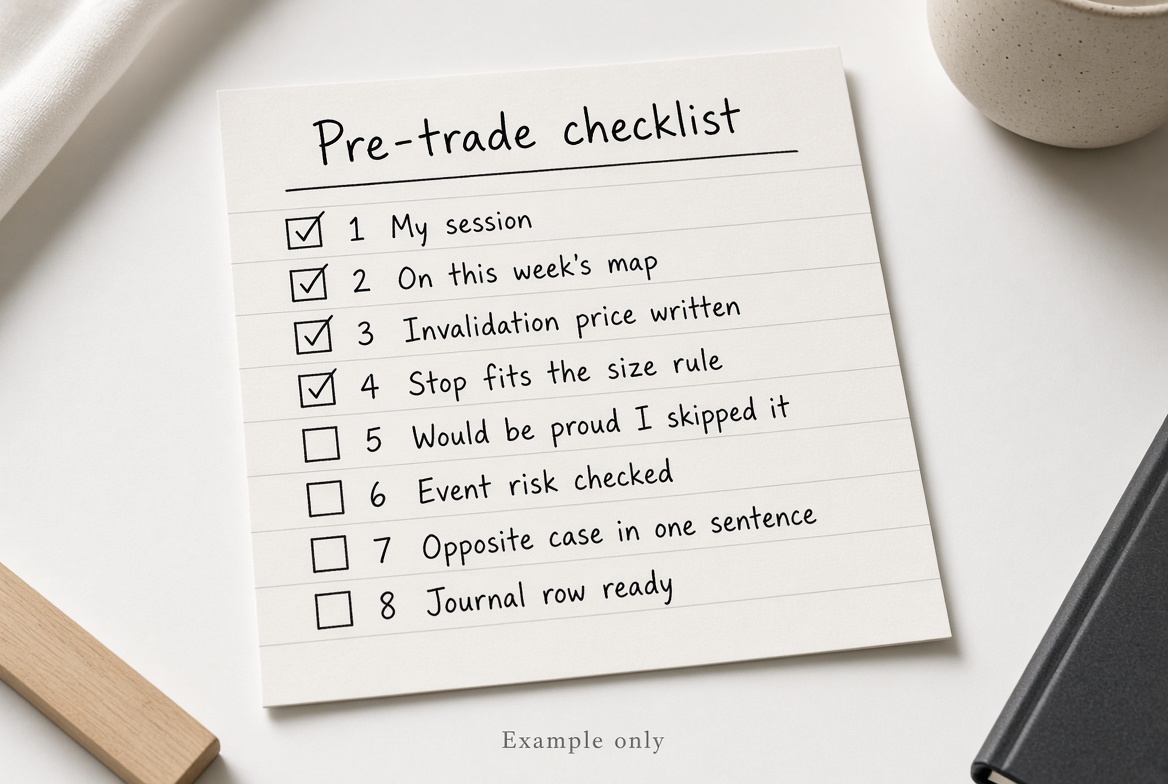
A setup can look clean and still be a bad trade. The difference, for me, is whether I can answer a short list without editing the answers to fit the chart.
I keep this next to the trading plan. The plan is the rulebook. The checklist is the gate.
The eight questions
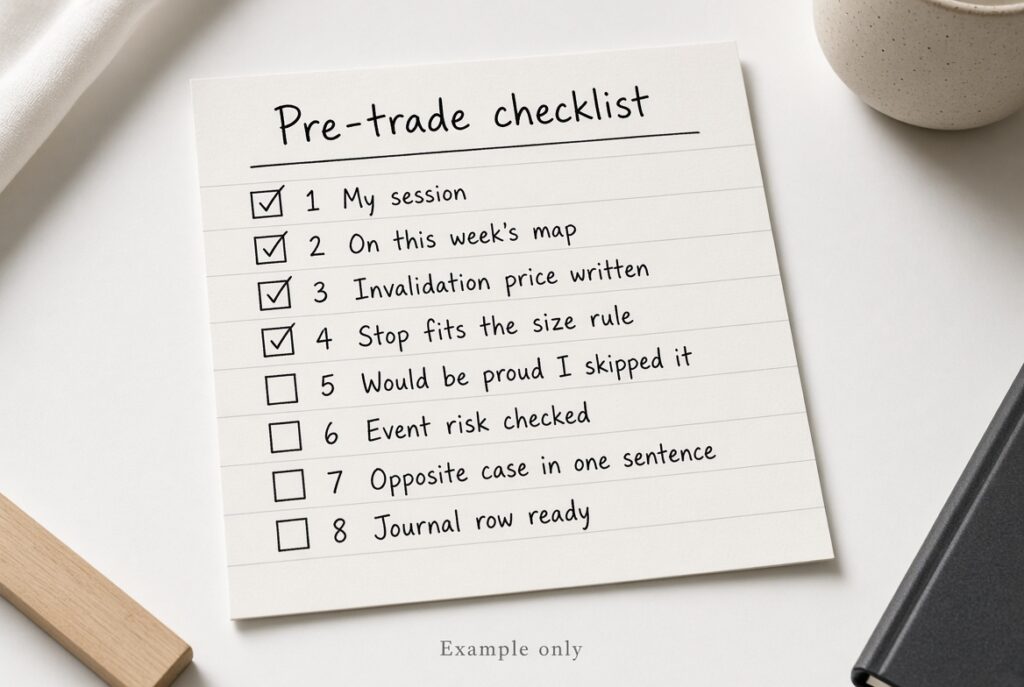
I run them in this order. If I fail one, I do not “size down and see.” I pass.
1. Is this my session?
If I am a swing trader writing this at 11 p.m. because a candle looks exciting, the answer is no. Session rules exist so fatigue does not get a vote. See also day trading vs swing trading.
2. Is this on the week’s map?
If the idea needs a level I did not mark before the week started, I am inventing. I can update a map after a real break. I cannot invent a level because I want in.
3. Where is invalidation, in a price?
“It should bounce” is not a stop. A number is a stop. If I cannot point to it, I do not have a trade.
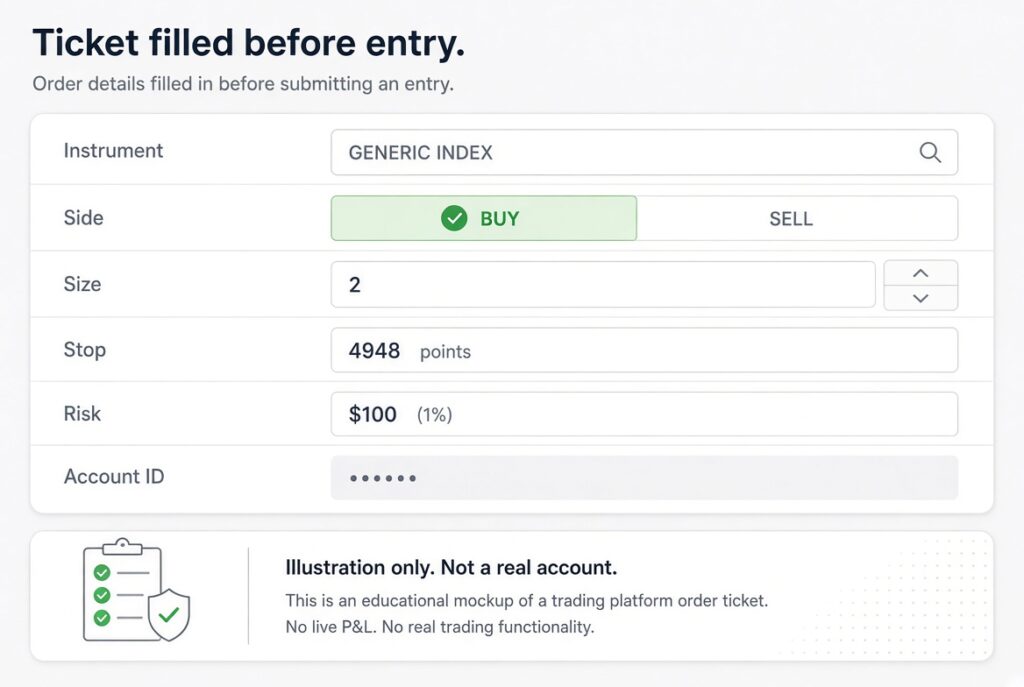
4. Does the stop fit the size rule?
Risk is a percent of the account, not a feeling. If the stop has to sit so far away that 1% risk makes the position tiny and not worth the attention, I pass. If I have to widen the stop so the trade “has room,” I am negotiating. The [position sizing notes](https://traderslook.com/2026/06/07/beginners-guide-to-risk-management-in-trading-position-sizing-stop-losses-and-risk-reward-ratio/) exist for this line.
5. What would make me proud I skipped it?
This is the question that kills the most ideas. If the honest answer is “nothing, I just want a fill,” that is FOMO with a collar on. I wrote about that pattern here: psychology and FOMO.
6. Is event risk inside the hold time?
A swing idea that dies on a CPI print is not a technical idea. It is a bet on a calendar. Either I cut size or I wait.
7. Can I state the opposite case in one sentence?
If I cannot say why a short would be valid, I do not understand the long. I do not need to take the opposite trade. I need to prove I am not stuck.
8. Is the journal row ready?
Instrument, direction, reason, stop, size, screenshot. If I will not write it, I should not click it. The journal guide is the longer version of this box.
What I do not put on the list
– “Do I feel confident?”
– “Is this the best trade of the month?”
– “Will I be annoyed if it runs without me?”
Those questions always vote yes.
A worked pass
Suppose a daily level is nearby and the session is my session. Stop is clear. Size at 1% is reasonable. But a central-bank decision lands in six hours and my hold time is “until the close.” That fails question 6. I do not rewrite the hold time to “I’ll be quick.” I stand down.
The checklist is useful only if failing a line means no trade. If every fail becomes “half size,” you do not have a checklist. You have a permission slip.