A new idea feels like an upgrade. It is usually an unpaid experiment.
I do not put full size on a pattern I just named. I run a live sample with a cap, then I either promote it or I kill it. That is the live half of the backtesting notes.
The sample
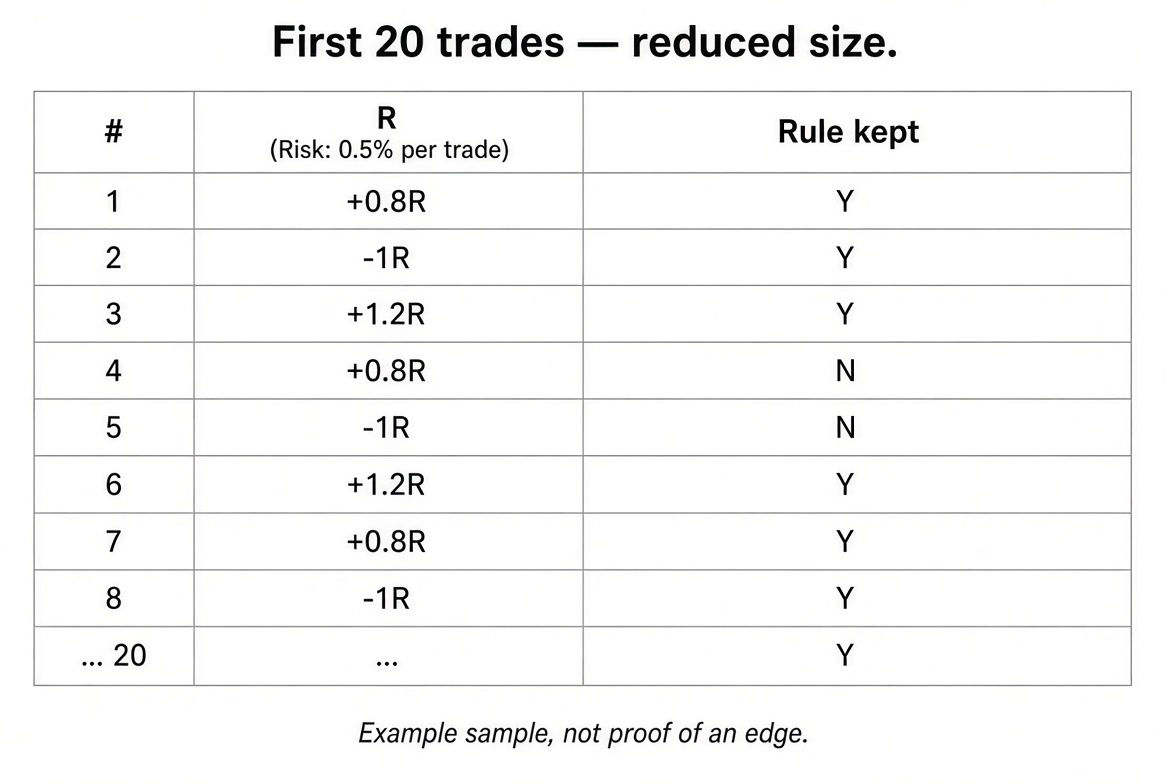
Twenty trades. Same market, same session, same definition of entry and stop.
Why twenty: it is enough to see whether I can execute the rule when I am bored or sore. It is not enough to prove an edge. Anyone who tells you twenty trades proved a system is selling certainty.
Risk during the sample
Half of normal, or less. If normal is 1% of equity per trade, the sample is 0.25–0.5%.
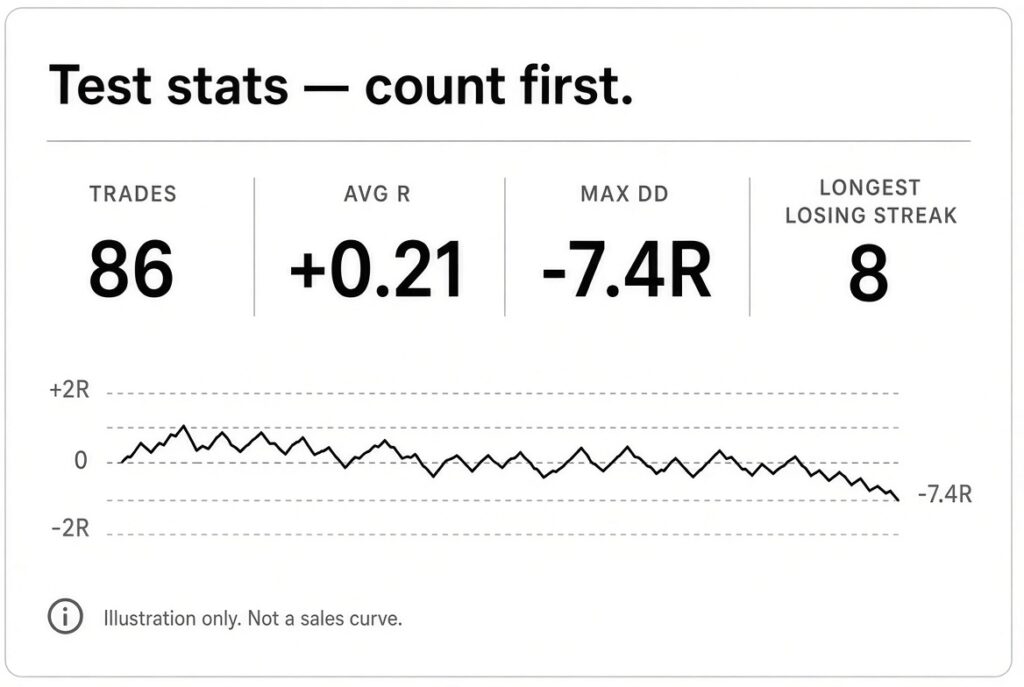
Hard stop for the whole test: if the sample is down 5R before trade 20, the idea is paused. I do not “finish the sample” into a hole. The pause is the result.
What must be written before trade 1
– Entry rule in one sentence
– Stop rule in one sentence
– When I will not take it (news, time of day, third push)
– Promotion rule: what would make me go to full size later
– Kill rule: see the later note on deleting a strategy.
If I cannot write those five lines, I do not need twenty trades. I need more thinking.
What I measure
Not net dollars. I measure:
– Did I follow the rule on each trade? (yes/no)
– R distribution
– How many trades I skipped that still fitted the rule (that is fear, log it)
– How many I took that did not (that is itch, log it)
If execution is sloppy, the idea is not on trial. I am. I fix execution before I judge the setup.
Promotion is boring
After twenty trades, if I still have a pulse and the rules were followed, I may move toward normal size over another block. I do not triple size on trade 21 because the sample was green.
A green sample with three F-grade winners is a fail. A flat sample with twenty A-grade executions is more useful. The second one I will keep studying. The first one I will not increase.
This is how a desk stays small on purpose until the idea earns the right to be large.