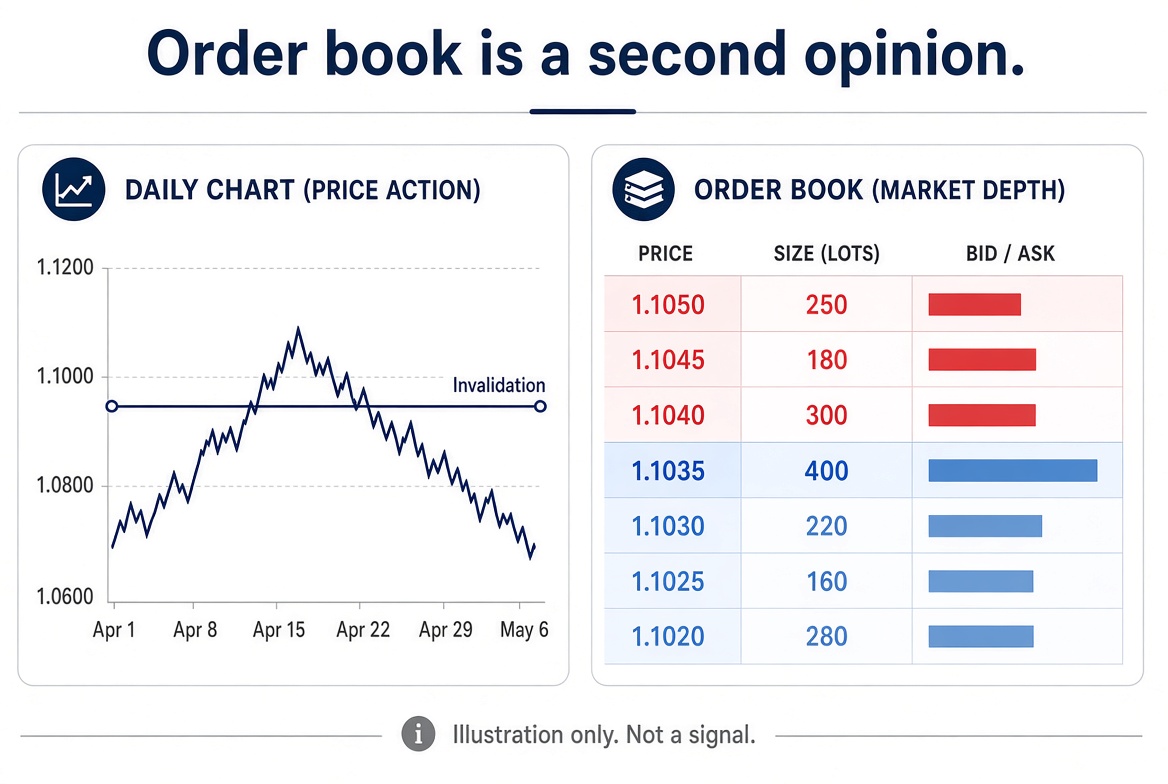
I watch the order book. I do not trade it as a system.
Price action and the weekly map still decide whether I am allowed to care. The book is what I open when price is already at a level I marked. It answers a smaller question: is anyone actually there, or is the level just a line I drew on Sunday?
That split matters. A thick bid can vanish in one print. A thin offer can be the only real seller. If I let the book pick the trade, I am reacting to a screen that changes faster than my plan.
When I open it
Three cases. Otherwise it stays closed.
- Price is at the invalidation line from the daily map, and I want to see if size is leaning there before I treat a break as real.
- A breakout candle looks clean on the chart and the book is empty. That is a reason to wait, not a reason to chase.
- I am already in a swing and a news window is close. The book does not tell me the print. It tells me whether I am about to sit in a vacuum.
If the level was not on the Sunday map, I do not go hunting in the book for a new one.
What I refuse to do with it
I do not fade a daily trend because a large bid appeared. I do not add size because the tape “feels” sponsored. I do not move a stop because the book shifted two ticks. The stop still belongs beyond structure, which is the same rule as the risk page.
Order-book screenshots also lie after the fact. The stack you remember is not always the stack that was there. If I use it, I note one sentence in the journal: “book supported the level” or “book was empty, I waited.” That is the whole log.
A simple hierarchy
- Weekly and daily map: am I allowed to have a bias?
- Invalidation: where is the idea dead?
- Book and tape: only at that level, only as a veto or a wait.
If step 3 disagrees with step 1, step 1 wins unless step 2 has already broken. The book does not get a vote on a fresh idea in the middle of last week’s range.
This is education, not a tape-reading course. If you do not already have a written invalidation, the book will give you a new excuse every thirty seconds.